
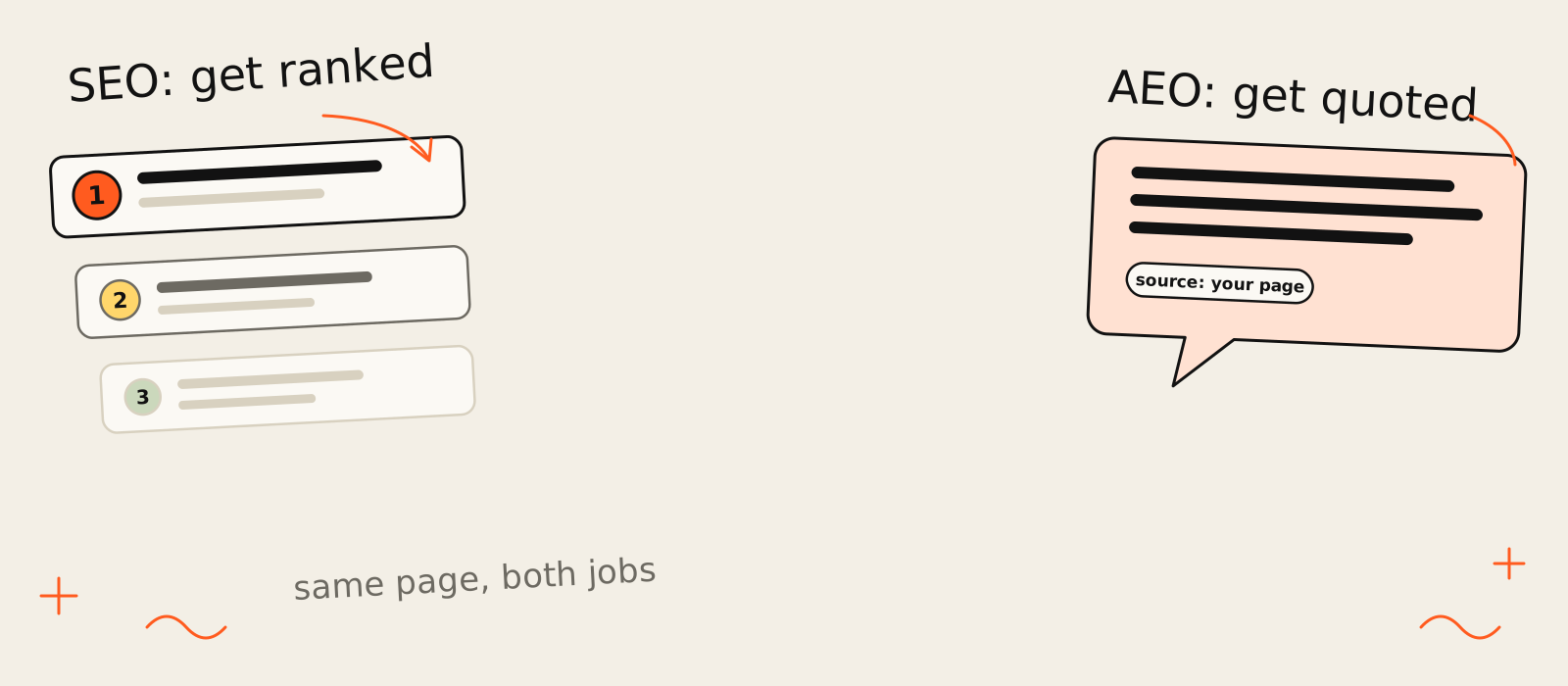
AEO vs SEO sounds like a choice between two teams. In practice it's one team with a slightly longer checklist, and most of the extra items fit on a sticky note.
I've seen this play out more than once. A founder sees a scary chart about AI Overviews, then asks whether they should hire "an AEO person". The short answer is no. The longer answer comes with numbers, because none of the top-ranking guides on AEO vs SEO bother to show how much traffic AI answers actually send.
What is the difference between SEO and AEO?
SEO gets your pages ranked in search results so people click through to your site. AEO, answer engine optimization, gets your brand named or cited inside the answer that ChatGPT, Perplexity or Google's AI Overviews write. The content and most of the work are the same. The scoreboard is different. SEO counts rankings and clicks, AEO counts mentions and citations.
What is SEO?
Search engine optimization is the work of getting a page to rank in Google and Bing for the searches your buyers make. Crawlable pages, content that answers the search, links from sites people trust, and a site that loads before the visitor gives up. The reward is a click, and the click is where your signup form lives.
What is AEO?
Answer engine optimization is the same idea pointed at a different reader. An assistant like ChatGPT or Perplexity, or Google's own AI Mode, reads a handful of pages and writes one answer. AEO is about being one of the pages it reads and, better, the brand it names. You'll also see it called GEO or LLMO. Same thing, different conference.
AEO vs SEO side by side
SEO and AEO share a foundation but get judged differently. SEO is scored on where a page ranks and whether people click. AEO is scored on whether an AI answer mentions or cites you, which often happens without anyone clicking at all. This is how the two compare on the things that decide where your time goes.
| SEO | AEO | |
|---|---|---|
| Goal | Rank a page and earn the click | Get named or cited in the AI answer |
| Where it shows | Google and Bing results | AI Overviews, AI Mode, ChatGPT, Perplexity, Gemini |
| Typical query | Short keywords | Long, conversational questions |
| What it rewards | Relevance, authority, technical health | Clear answers, authority, mentions on other sites |
| How you measure it | Rankings, clicks, signups | Mentions, citations, share of voice |
| Main headache | Slow to build | Hard to measure |
How do AI answer engines choose what to cite?
Google's AI features pick sources with the same systems that rank normal search results. Its guide describes two techniques: retrieval-augmented generation, where the model pulls relevant pages from the search index before it writes, and query fan-out, where it runs several related searches at the same time. If a page can't rank, it can't be retrieved.
That last part is the bit people skip. To appear in AI Overviews or AI Mode, a page has to be indexed and eligible to show with a normal snippet, according to Google's guide to its generative AI features. There's no side door.
Fan-out is easier to picture with an example. Ask for the best CRM for a ten-person sales team and the model may also look up pricing, integrations and reviews of the tools it finds. Each of those is a normal search with normal rankings, which is why one strong comparison page can show up in several answers.
Other assistants behave a little differently. When Semrush compared AI answers with Google's results, AI leaned on trusted domains but often cited deeper pages than the one that ranked, and ChatGPT's sources overlapped least with Google's top 10. So authority carries over. Rankings only partly do.
Is AEO replacing SEO?
No. Google's own guide asks whether SEO is still relevant for AI search and answers "In short, yes!", because AI Overviews and AI Mode run on its core ranking and quality systems. AEO is SEO with a few extra habits, and those habits matter more for ChatGPT and Perplexity than for Google itself.
I used to think AEO was a rebrand invented by people who sell dashboards. I've softened, a bit. The extra habits are real, and most of them are cheap. What doesn't hold up is the idea that you need a separate strategy, a separate team and a separate budget. Same homework, different exam.
How much traffic does AEO actually drive?
Less than the panic suggests. Across about 10,000 US sites, AI assistants sent roughly one visit in every 200, about 0.5% of all traffic, while organic search still delivered around 18%, according to Similarweb data analysed by Kevin Indig. AI referrals are the fastest-growing channel. They're also still a rounding error with good manners.

None of the top-ranking guides put numbers on this, so here they are:
- AI referrals equal about 2.85% of organic search traffic in the US (Kevin Indig, Growth Memo).
- US organic visits fell 13.2% over two years while paid search grew 21%. Some of the lost clicks went to ads, not to AI.
- AI Overviews appear on about 16% of US searches, and the top organic result loses about 34.5% of its clicks when one shows up (Ahrefs).
- People click a regular result 8% of the time when there's an AI summary, against 15% without one (Pew Research).
- The visitors who do arrive from AI convert well. Semrush puts the average AI visitor at 4.4 times the value of an organic one (Semrush), and Ahrefs saw 23 times better conversion on its own site. Both are vendor numbers, so treat them as a direction, not a forecast.
My read, and it's an opinion more than a law: don't make AI referral traffic your main KPI yet. Track whether you get named when buyers ask about your category, and keep SEO as the channel that pays the bills. The clicks AI Overviews take away are real. The clicks AI assistants send back are, for now, small.
What stays the same and what AEO adds
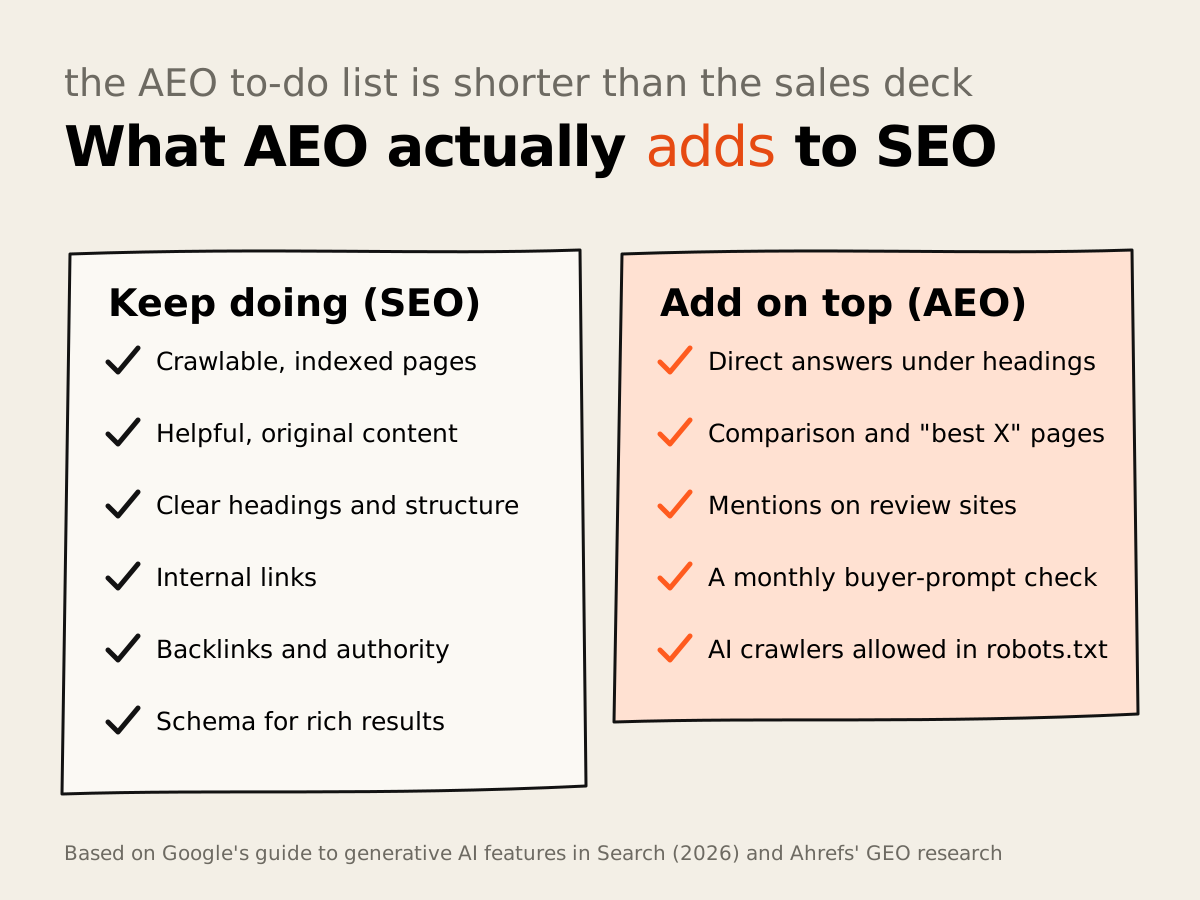
Most of AEO is SEO done properly. Crawlable pages, original content, clear structure and authority get you into Google's AI answers the same way they get you ranked. What AEO adds is a short list: direct answers under each heading, comparison pages, mentions on other sites and a monthly check of what assistants say about you.
What you keep doing from SEO
- Pages Google can crawl, index and show with a snippet.
- Content with a point of view. Google's guide says plainly that a summary of what's already online adds little, and that a first-hand take is what stands out.
- Clear headings and sections, written for people.
- Internal links between related pages.
- Backlinks and a reputation people can check.
- Structured data, for rich results.
What AEO adds on top
- A 40 to 60 word answer right under each heading, so the passage still makes sense when it's lifted out on its own.
- Comparison pages and "best X for Y" pages, because those are the prompts where assistants name brands.
- Mentions on other sites. In Ahrefs' research, most brand mentions in AI answers came from third-party pages, and branded web mentions had the strongest link to AI Overview visibility (a 0.664 correlation), ahead of branded anchors and branded search volume (Ahrefs).
- A list of the questions buyers ask, checked every month.
- AI search crawlers like OAI-SearchBot and PerplexityBot allowed in robots.txt.
What an answer-first section looks like
The fix is smaller than it sounds. I've seen this opening on more SaaS blogs than I'd like to admit, including a couple I worked on: "Customer churn has long been a challenge for growing companies, and understanding its many causes requires looking at several factors." That's 20 words and no answer.
Now try: "Monthly churn is the share of customers who cancel in a given month. To calculate it, divide cancellations by the customers you had on day one." An assistant can lift that as it is, and so can a busy reader. Both examples are mine, written for this article, so please don't quote them at your board.
AEO advice you can skip
A good share of AEO advice is busywork. Google's guide lists things you can ignore for its AI features: llms.txt files, "chunking" pages into tiny pieces, rewriting content in a special AI style and chasing inauthentic mentions. It also says structured data isn't required for AI features, which contradicts the guides from HubSpot and Salesforce that call FAQ schema the most important AEO lever.
I made this mistake myself. I once spent an afternoon writing a lovely llms.txt file. Google doesn't read it. It's still there, being lovely for nobody.
Keep schema for rich results, just don't expect it to be the AEO switch. And remember Google's guide only covers Google, so treat it as the floor, not the whole rulebook.
When should you lean on SEO and when on AEO?
Lean on SEO when people need depth before they decide, and on AEO when they want a quick answer or a shortlist. Pricing pages, long guides and anything you need clicks on are SEO first. Definitions, comparisons and "best tool for X" questions are where AI answers show up, so that's where the AEO habits pay off.
| Page or question | Lead with | Why |
|---|---|---|
| "What is X?" definitions | AEO | The answer often gets read without a click |
| "Best X for Y" and "X vs Y" | Both | Assistants name brands here, and buyers still click to compare |
| Pricing and product pages | SEO | Buyers want detail, and this is where signups happen |
| Long how-to guides | SEO | Depth earns the ranking. Put a direct answer at the top for AI |
| Review sites and roundups you don't own | AEO | Assistants quote them, so being listed counts |
That table is my judgement from working on SaaS sites, not a law of physics. I've seen it go wrong in both directions, usually when a team rewrites its pricing page as a Q&A because someone read a LinkedIn post. Check your own Search Console and your own buyer prompts before you trust my table.
What should a small SaaS team do first?
Start with the work that pays off in both places, then add the AEO extras. For a team of one to three people, that means five steps in this order: fix the basics, answer the questions buyers ask, build comparison pages, earn a few mentions, then check what assistants say every month.
- Fix crawling and indexing first. If a page isn't in Google's index, it isn't in Google's AI answers either.
- Write down 20 questions buyers ask, using sales calls and support tickets. Turn the best ones into headings with a direct answer underneath.
- Build the comparison pages you've been avoiding. Yes, including the one against your biggest competitor.
- Get onto the review sites and roundups that assistants already quote for your category.
- Run the same 20 prompts every month and note who gets named.
When I do this with a SaaS team, steps one and two take most of the first month, and that's fine. They're also the steps that move Google rankings, so nothing is wasted if AI search stalls.
If you'd rather have someone run the first pass, my SEO & AEO audit covers exactly this: where you show up, who gets cited instead, and what to fix first.
How to measure AEO next to SEO
Measure AEO with mentions, citations and AI referral visits, next to your usual rankings and clicks. You can start for free. Google Search Console now has a Generative AI performance report, and a monthly check of 20 buyer prompts across ChatGPT, Perplexity and Google shows the trend before you pay for a tool.
If you do get to the paying stage, I sorted AI SEO tools by job and price, including the ones I'd skip. For tracking mentions specifically, dedicated AI visibility tools can run your buyer prompts across ChatGPT, Perplexity and Google automatically.
Three numbers are worth tracking, in the order I'd add them:
- Mentions: how often assistants name you for your category prompts, compared with competitors.
- Citations: how often they link to your pages.
- AI referral visits, and what they turn into. In GA4, filter sessions by source with a pattern like this one.
chatgpt\.com|perplexity\.ai|gemini\.google\.com|copilot\.microsoft\.com|claude\.aiA spreadsheet is enough to start: one row per prompt, one column per assistant, and a note of who got named. Answers change from week to week, so read the trend, not a single run.
Where does GEO fit?
GEO, generative engine optimization, is mostly another name for the same work. Ahrefs uses GEO, AEO and LLMO interchangeably. Semrush draws a line between them, with AEO about being retrieved and cited when someone asks, and GEO about what a model already knows from its training data. Either way, the inputs barely change. Authority, clear content and mentions on other sites do the work.
AEO vs GEO deserves its own article, so I'll leave the acronym fight there. Same homework, different exam, more acronyms on the paper.
So, do you need an AEO person?
Back to the founder with the scary chart. Probably not. You need someone who does SEO properly and doesn't mind adding a sticky note's worth of new habits to the job. Most SaaS teams are closer to that than the sales decks suggest.
If that person already works for you, send them this article and go back to whatever you were doing before the chart showed up. And if they suggest an llms.txt file, tell them I've already spent that afternoon for both of you.
Frequently asked questions
Will AEO replace SEO?
No. Google's AI features run on its core search ranking systems, so the work that ranks a page is the work that gets it into AI Overviews. AEO adds a few habits on top of that.
Can one page rank in Google and get cited by AI?
Yes, and it should be the same page. A direct answer under each heading, real depth below it and a few links from trusted sites serve both.
How long does AEO take to show results?
It depends on how strong your SEO already is. A site that ranks can start showing up in AI answers fairly quickly once its pages answer questions directly. A site that doesn't rank has to fix that first.
Do I need schema markup for AEO?
No. Google says structured data isn't required for its AI features. It's still worth having for rich results in normal search.
Do backlinks still matter for AI answers?
Yes. They still build the authority that Google's systems rank on, and in Ahrefs' data, mentions of your brand on other sites, linked or not, track closely with AI Overview visibility.
How do I know if ChatGPT mentions my brand?
Ask it. Run the questions your buyers ask in ChatGPT, Perplexity and Google every month and note who gets named.
