
AI SEO tools are three different purchases wearing one label: trackers that show whether AI answers mention you, content tools that help you write pages that rank, and automation tools that run the repetitive work. Most small teams need one of those at most, plus Search Console and a general LLM.
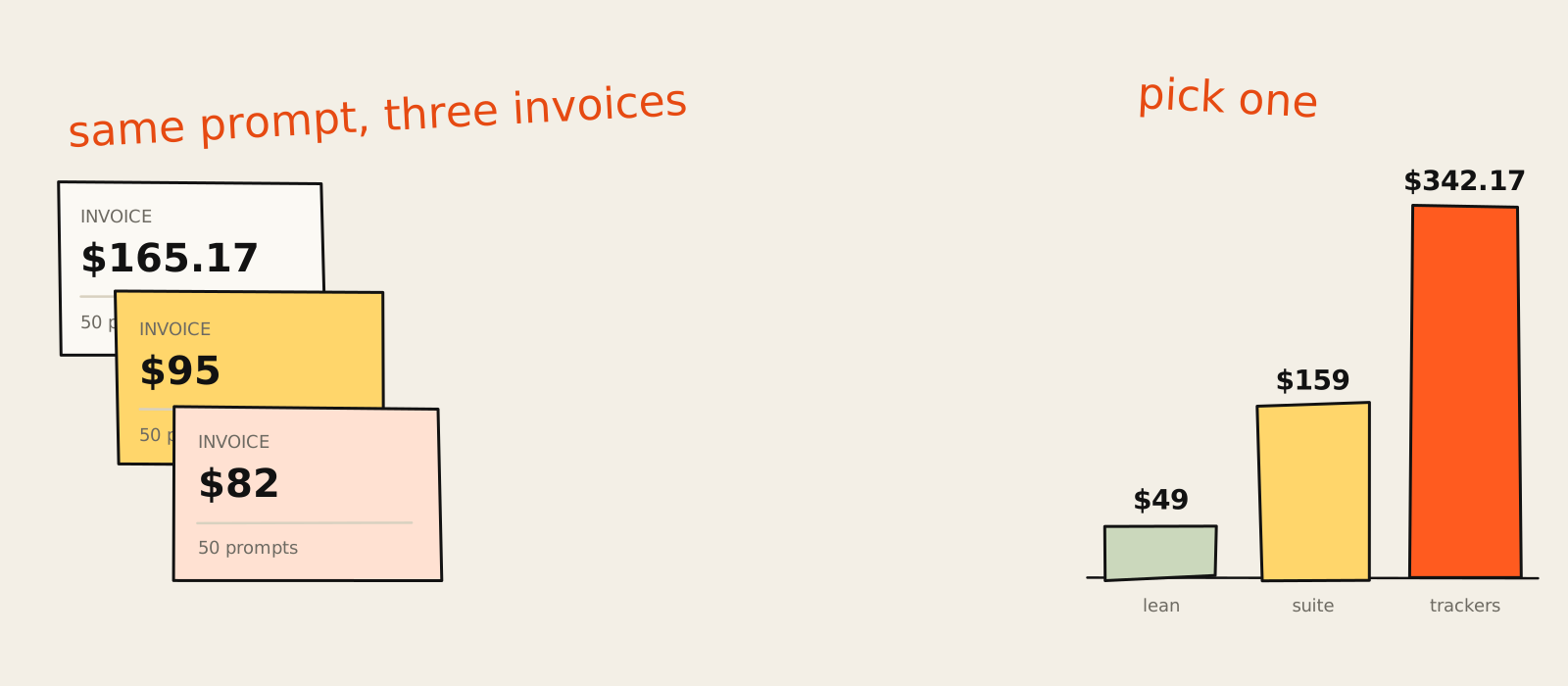
Most of the lists ranking for this term are written by someone selling one of the tools, or by someone with a coupon code to hand out. Nobody totals the bill, so I did. Three AI visibility trackers at 50 prompts each come to $342.17 a month at today's prices, and they all watch the same questions. Same prompt, three invoices.
Prices below come from vendor pricing pages, checked on October 30, 2026, and they will move. There are no affiliate links in this article. The verdicts are my opinion, from years of running SEO and growth at SaaS companies. I didn't lab-test 20-odd tools side by side, and I'd be suspicious of anyone who says they did.
What are AI SEO tools?
AI SEO tools are software that uses large language models or machine learning to handle an SEO job: finding keywords, writing and scoring pages, changing sites, or tracking where AI answers mention you. The phrase "AI powered SEO software" now covers products with almost nothing in common, which is why comparing them gets confusing.
A lot of AI SEO software is older SEO software with an AI tab added. Fair enough. Semrush and Ahrefs hold data a chatbot doesn't have, and a chatbot sitting on that data is useful. The trouble starts when a prompt tracker and a writing assistant land in the same ranked table, which is a bit like ranking a smoke alarm against a frying pan.
The three kinds: AI search visibility, content optimisation, workflow automation
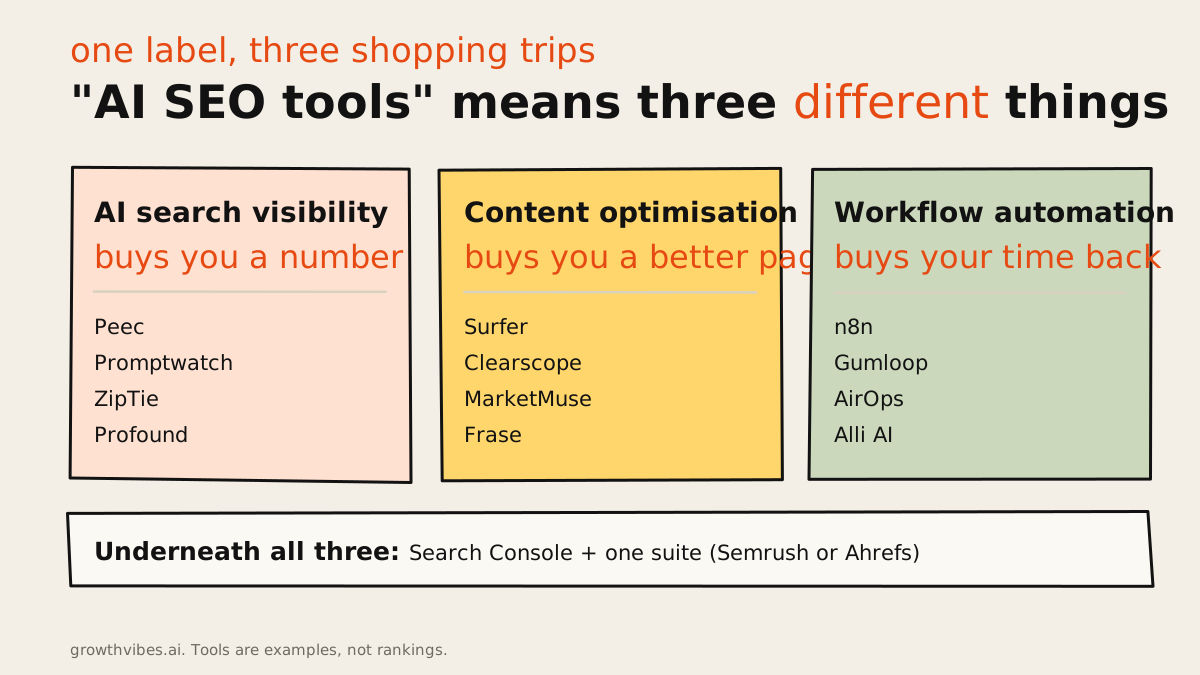
- AI search visibility tools run a list of prompts through ChatGPT, Gemini, Perplexity and Google's AI features, then report how often you appear. They buy you a number. They don't change it.
- Content optimisation tools compare your draft with what already ranks and tell you what's missing. They buy you a better page, provided the writer has something to say.
- Workflow automation tools chain steps together: scrape, summarise, draft, push to a sheet. They buy your time back, after you've spent some of it building them.
The suites (Semrush, Ahrefs, SE Ranking) sit underneath and increasingly dabble in all three. That's why the first question is always which job you're hiring for.
How to choose an AI SEO tool
Choose an AI SEO tool by naming the job first, then checking four things: whether its data is accurate enough to act on, whether it connects to what you already use, what it costs at your real volume, and whether it suits your team size. Ignore the feature grid until you've done that.
Accuracy, integrations, price, fit for team size
- Accuracy. Can you see where a number came from? If the tool shows a score and no working, you can't tell a real drop from a bad sample. There's a three-step test further down.
- Integrations. An export or API you can feed to an LLM often beats the dashboard. Frase, for example, lists 5,000 API, MCP and CLI requests a month on its $39 plan, which tells you who they think is coming.
- Price at your real volume. Starter plans are the hook. Promptwatch goes from $95 for 50 prompts to $245 for 150 and $579 for 350. Work out the plan you'd be on in six months and judge that one.
- Fit for team size. Clearscope's next plan up is $399 a month, and AirOps titles its pricing page "AI Search for Enterprise". If you're one person, every extra login is one more dashboard nobody opens on a Tuesday.
At one of the SaaS companies I worked with, we paid for two suites at once for most of a year, because each had one report somebody liked. Nobody had asked which report changed a decision. When we did ask, the answer was awkward, and the renewal got easier.
Best AI SEO tools compared
The best AI SEO tools depend on the job: Semrush or Ahrefs for research, Frase or Surfer for content, one tracker such as Peec or Promptwatch for AI visibility, Screaming Frog for crawling, n8n for automation, and Claude or ChatGPT for everything in between. Search Console sits underneath, and it's free.
If you came for the SEO AI tools list, here it is, sorted by job instead of by rank. Prices are USD per month unless stated, checked October 30, 2026. "Annual" means billed yearly.
| Tool | Best for | Starting price | Verdict |
|---|---|---|---|
| Search Console | Your real search data | Free | Start here, whatever else you buy |
| Semrush | One login for everything | $117.33 annual, $139 monthly | Best if you want one bill |
| Ahrefs | Links and keywords | $29 (Starter, limited) | Cheapest way into a suite |
| SE Ranking | A cheaper suite | $103.20 annual, $129 monthly | Compare the limits first |
| Keyword Insights | Keyword clustering | $58 | Only for big keyword lists |
| AlsoAsked | People Also Ask questions | $12 annual | Cheap, narrow, useful |
| Frase | Briefs and optimisation | $39 annual, $49 monthly | Cheapest sensible content tool |
| Surfer | On-page scoring | $99 | Fine if you publish weekly |
| Clearscope | Content teams | $129 | Good, priced for teams |
| MarketMuse | Big content libraries | Free tier, paid plans by demo | Overkill for a small site |
| Jasper | Brand voice across writers | $59 per seat annual, $69 monthly | Skip it if you are solo |
| Claude or ChatGPT | Briefs, analysis, drafts | $20 | The one everybody needs |
| Peec | AI visibility tracking | $95 (50 prompts, 3 models) | Good single tracker |
| Promptwatch | AI visibility tracking | $95 (50 prompts) | Good single tracker |
| ZipTie | Pay-per-check tracking | About a cent per engine check | Worth pricing up |
| Profound | Enterprise AI visibility | Free trial, then by sales | Not for small budgets |
| Screaming Frog | Technical crawling | Free to 500 URLs, $279 a year | Best value on this list |
| Alli AI | On-page changes without devs | $249 annual, $299 monthly | Only with no developer time |
| Gumloop | No-code AI workflows | $37 | Fast to start |
| n8n | Workflows you own | Free self-hosted, $20 annual | Best if you can maintain it |
| AirOps | Content ops at larger teams | Start free, then by sales | Too much for one person |
Best AI SEO tools for research and keywords
For research and keywords, pay for one suite: Semrush if you want everything in one login, Ahrefs if links matter most or you want the cheapest way in. Add Keyword Insights or AlsoAsked only for a specific gap, because clustering and question mining are narrow jobs you may not do every week.
Semrush has two plans worth reading closely. Its SEO plan is $117.33 a month on annual billing ($139 monthly) with 500 keywords and basic AI tracking. Starter is $165.17 ($199 monthly) and tracks 50 AI prompts daily, which makes a separate tracker hard to justify at small volumes.
Ahrefs starts at $29, then jumps to $129 for Lite and $249 for Standard. Starter is limited, so expect to outgrow it. It also sells prompt tracking separately through Brand Radar: $50 a month for 2,500 checks, roughly 80 prompts a day on one platform.
SE Ranking is $103.20 on annual billing ($129 monthly). That's $14.13 under Semrush's annual SEO plan, so the sticker alone won't decide it. Compare the keyword and report limits for your site.
Keyword Insights ($58) groups keywords by the pages that rank for them, which earns its fee once you have thousands to sort and not before. AlsoAsked ($12 billed yearly) maps People Also Ask questions, which is handy for FAQs and for what buyers worry about.
I've seen this play out more than once: two suites return very different search volumes for one keyword, and both are extremely confident. Treat volumes as a rough range, and use Search Console for anything you already rank for. It's the only number in this section that comes from Google's own logs of your site.
Best AI SEO tools for content
For content, the best AI SEO tools check a draft against what already ranks and leave the thinking to you. Frase is the cheapest sensible start, Surfer and Clearscope suit teams publishing every week, and Jasper only makes sense when brand voice across several writers is the actual problem.
- Frase: $39 on annual billing ($49 monthly) for 10 articles, 25 AI generations and 20 tracked AI prompts a month.
- Surfer: Standard is $99 a month, and includes 25 prompts tracked weekly on ChatGPT only.
- Clearscope: Essentials is $129 a month. Business is $399.
- MarketMuse: a free tier with 10 queries a month. Paid plans go through a demo and no price is listed, and it's built around auditing a big existing library.
- Jasper: Pro is $59 per seat on annual billing ($69 monthly).
- Claude or ChatGPT: $20 a month each. Neither knows your search data until you paste it in, so paste it in.
A content score tells you what the current top ten have in common. It can't tell you what to write first. At Moosend we scored every keyword by how hard it was to win against what it was worth, wrote bottom-of-funnel pages first and built clusters from there. The SEO and YouTube growth case study has the detail. That call came from understanding the business, and I wouldn't expect a score out of 100 to make it for you.
You can get a lot of the brief work done with an LLM and five minutes of copying. This is the kind of prompt I'd start from:
Below are the top 5 ranking pages for my keyword.
List what every page covers, what only one page covers, and what none of them answer.
Then list 5 questions a buyer would still have after reading all five.
Quote the page for each claim. Do not write the article.
Best AI SEO tools for AI search visibility
For AI search visibility, buy one tracker at most, and only after a free manual check. Semrush Starter is the obvious pick if you already want the suite. Peec and Promptwatch both start at $95 a month for 50 prompts, and Profound is built for enterprise budgets. None of them raise your visibility by themselves.
- Peec: $95 a month for 50 prompts on 3 models, with 15% off on annual billing.
- Promptwatch: $95 a month for 50 prompts across 7 engines. The platform also covers citations and crawler logs.
- Surfer AI Search Analytics: $82 a month on annual billing for 50 prompts refreshed daily.
- ZipTie: prices itself at about a cent per engine check, with a 7-day trial. Worth pricing up against your own prompt count.
- Indexly: $99 a month for AI visibility. The company also sells content agents.
- Profound: a free trial of 50 prompts, then enterprise pricing through sales.
Before any of that, do what I covered in AEO vs SEO: run about 20 buyer prompts by hand once a month and read the Generative AI performance report in Search Console. It's free. It stops being practical somewhere past a few dozen prompts, which is the moment a tracker starts to earn its fee.
Keep the size of this in proportion, too. Kevin Indig's analysis of Similarweb data puts AI assistants at about 1 in 200 visits. Being named when buyers research your category still matters, and I'd measure it. I wouldn't spend $342.17 a month watching it on a small team. Same prompt, three invoices.
Can these tools help you get cited? Mostly they tell you where you stand. The work that moves the number is what you'd expect: answers near the top of pages, comparison pages, and mentions on other people's sites.
Best AI SEO tools for technical SEO and automation
For technical SEO and automation, Screaming Frog does the crawling for $279 a year, and n8n or Gumloop run the repetitive work around it. Alli AI makes sense when you can't get developer time. AirOps targets bigger content teams. Automate checks and reporting first, because they pay back faster than automated drafts.
Screaming Frog is free up to 500 URLs and can now call OpenAI or Gemini during a crawl, so you can ask a question of every page on your site. Alli AI is $249 on annual billing ($299 monthly) for five sites, and it pushes on-page changes for you. Be sure you trust what you're giving write access to. AirOps lets you start free and quotes the rest through sales.
Gumloop is $37 a month for 20,000 credits and is the faster way to get something running. n8n is free to self-host, or $20 a month billed annually for 2,500 executions. It takes longer to learn, and you own what you build.
If you'd rather build a small tool of your own than rent one, I ranked vibe coding tools by what you're building.
At Synthesia I built automated checks that surface critical technical issues and send alerts, plus agents for scraping, reporting, competitor research and outreach. It's in the product-led SEO case study. The checks were the part I'd copy first. An alert that a key page fell out of the index beats a hundred drafts.
Paid tool or your own workflow? The tool bill is rarely the issue. As an example, 1,000 runs a month on n8n Starter plus about $11 of Claude API usage comes to $31. The real cost is the person who fixes it when a site changes its HTML at 11pm, and no support team is coming for your scraper. If you'd rather not be that person, that's what my AI agents and automation builds are for.
If you go the own-workflow route, my guide to building AI agents covers it from the first prompt to production.
For the other jobs an agent can take off your plate, and which ones to keep a human on, see AI marketing agents: what they can run for you today.
A small warning about lists: one guide I read has Indexly from $14 a month, and its pricing page now says $99. Check the vendor's page before you budget from anybody's table, this one included.
Best free AI SEO tools
The best free AI SEO tools are Google Search Console for real search data, Screaming Frog's free crawler for up to 500 URLs, and the free tier of ChatGPT or Claude for briefs and analysis. Quattr, AIOSEO's analyzer and seo.ai add useful single-purpose checks. Together they cover more than most small sites use.
- Google Search Console: your actual queries, clicks and positions, plus the Generative AI report. It only shows your own site, so it won't help with competitors.
- Screaming Frog: the free version covers broken links, redirects, titles and more, up to 500 URLs.
- Quattr's free tools: small generators for title tags, meta descriptions, H1s and URLs. They're separate tools and don't add up to a workflow, as eesel notes.
- AIOSEO's analyzer: a free on-page checklist. It tells you what's wrong and leaves the fixing to you.
- seo.ai's free tools: a keyword generator and a SERP simulator. Eesel listed the main platform from $149 a month in January 2026.
- MarketMuse's free tier: 10 queries a month, enough to see whether you like the idea.
One caution with free keyword generators. Ask an LLM for keywords and you get plausible phrases with no demand data behind them. Check them against Search Console or a suite before you plan a quarter around them.
The stack I would run as a one-person team
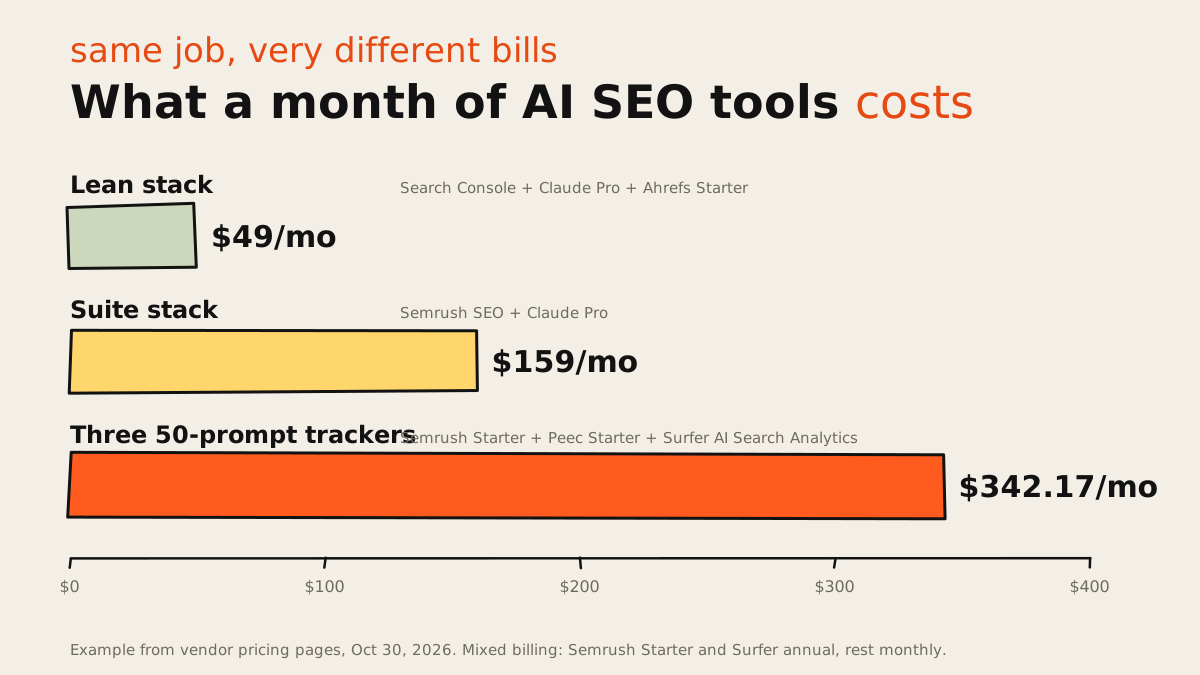
As a one-person team I would run Search Console, Claude Pro and Ahrefs Starter for $49 a month, moving to Semrush SEO and Claude Pro at $159 once I needed more keyword tracking. I'd add one tracker only when a monthly manual check stopped being enough. That's an opinion, and it has limits.
| Stack | What is in it | Per month |
|---|---|---|
| Lean | Search Console $0, Claude Pro $20, Ahrefs Starter $29 | $49 |
| Suite | Semrush SEO $139, Claude Pro $20 | $159 ($134.33 on annual billing) |
| Suite with tracker | Semrush Starter $165.17 annual, Claude Pro $20 | $185.17 |
| Overlap | Semrush Starter $165.17, Peec $95, Surfer AI Search Analytics $82 | $342.17 (mixed billing) |
Treat these as example calculations from October 30, 2026. The gap between the top and bottom rows is $293.17 a month, or $3,518.04 a year, which buys a lot of pages with actual reporting in them.
Today, I would start lean and let the work force each upgrade. If keyword limits start getting in the way, move to the suite. If 20 prompts by hand becomes 60, add tracking. A team tracking hundreds of prompts, or working across many clients, will outgrow all of this quickly, and Ahrefs Starter runs out of road sooner than the others. This is how I think about a small operation, and I wouldn't assume it fits an agency.
Not sure what your own site needs before you buy anything? That's the first thing my SEO & AEO audit answers.
AI SEO tools I would skip
I would skip overlapping AI trackers, standalone AI writers that bring no data of their own, keyword tools that only reformat what an LLM says, and anything charging for llms.txt or "AI-ready" markup. These are my opinions, and a specific team could reasonably disagree with any of them.
Before you start throwing subscriptions at this, my rules:
- No second tracker. At 50 prompts they all answer the same question, and the bill for three is $342.17 a month.
- No writer without data. I can't prove any given product is a thin wrapper, because I haven't seen their code. The test I use is simple: what does it know that Claude doesn't? If the answer is a template and a nice interface, the $20 subscription covers it.
- No paying for llms.txt. Google says Search doesn't use these files or special AI markup. That covers Google only, so other engines may differ. It's still no reason to pay someone for a text file.
- No one-click publishing. A button that ships a hundred posts is a button that ships a hundred posts nobody checked.
- No enterprise plan for a 20-prompt problem. If the sales call is longer than your prompt list, you're in the wrong room.
I know some people will say a specialist tool beats a suite at its one job. Often it does. The question is whether you do enough of that job to notice. I used to think more tools meant better decisions. I don't anymore, because the reports I've watched change a decision came from a small number of sources somebody actually trusted.
Same prompt, three invoices.
How to test a tool's accuracy before you pay
To test an AI SEO tool before paying, compare its numbers with data you already trust, re-run the same query several times, and read the raw output. Keyword and ranking tools can be checked against Search Console. AI trackers need repeated runs, because a single AI answer tells you very little about your visibility.
None of the top guides I read explain why this matters for trackers. Rand Fishkin at SparkToro, with Patrick O'Donnell of Gumshoe.ai (an AI tracking vendor, worth knowing), had 600 volunteers run 12 prompts through ChatGPT, Claude and Google's AI a combined 2,961 times.
Fishkin's conclusion is fair to the trackers: visibility across many runs is a reasonable signal, and a "ranking position" inside an AI answer isn't one. So I treat these numbers as samples, not rankings. I hold that with some caution, because the study used a small set of prompts and good trackers average out a lot of the noise.
I've made a version of this mistake myself. I once sent round a screenshot of an AI answer naming a client first, like a trophy. I ran the same prompt an hour later and the client was gone. Here's the test I'd run during any trial:
Check it against Search Console
Pick 10 queries you already get clicks for. Compare the tool's positions and estimates with your real data. Big, unexplained gaps mean trouble.
Run the same thing several times
Run five prompts by hand, a few times each, and compare with what the tracker reports. If it shows one run as a fact, be careful.
Read the raw output
Open 20 answers or reports and read them. Did it count a passing mention as a win? Is the competitor set real?
Then ask the vendor four questions, adapted from Searchable's tracking guide. Searchable sells tracking, so read its data with that in mind:
- How many runs per prompt, per engine?
- Can I see the raw answers?
- Are branded and unbranded prompts reported separately?
- What counts as a mention?
The third one matters most. Searchable's September 2026 data has the median brand named in 93% of branded answers and 7% of unbranded ones, so a prompt list stuffed with your own name will flatter you beautifully.
Using AI SEO tools without getting penalised
You won't get penalised just for using AI SEO tools. Google says "appropriate use of AI or automation is not against our guidelines", and it judges the page, however it was made. The risk is publishing many low-value pages fast, which falls under its scaled content abuse policy, whoever wrote them.
Google's guidance on generative AI content and its spam policies are short and worth reading. The policy targets many pages made mainly to manipulate rankings. Where the exact line sits, I don't know. Google doesn't publish a number, and anyone quoting you a safe pages-per-week figure is guessing.
- Fact-check everything, including titles and meta descriptions. Google specifically says to review AI output for accuracy before publishing, because these models predict words. They don't look facts up.
- Add something the model doesn't have: your data, your screenshot, what happened when you tried it.
- Publish at the speed you can review. If nobody read it, don't ship it.
- Put a real person's name on it, and make sure that person would defend it.
- Watch Search Console after each batch, by page group, so a problem shows up in weeks and not at the next quarterly review.
Scale can be fine. At Synthesia I planned and launched 60+ multilingual landing pages programmatically, and we worked with the localisation team so each page fit its market. That second part is the bit a one-click tool leaves out.
What I'd put on the card
Back to those three invoices. If you're paying all of them, keep the one that shows you raw answers and cancel the other two this week. If you're paying none, even better: start with Search Console and a $20 LLM, run your 20 prompts by hand for a month, and write down what you genuinely missed.
Most of these tools will still be around next month, probably with a new AI tab. If you still want one by then, you'll know which question it's answering. And if a best-of list ranks its own product first, fine. Mine ranks nobody, which is doing wonders for my affiliate income.
Frequently asked questions
Which AI tool is best for SEO?
It depends on the job. Semrush or Ahrefs for research, Frase or Surfer for content, and Screaming Frog for crawling. If you buy just one thing, make it a $20 LLM alongside the free Search Console.
The comparison table above has every tool with its price and my verdict, sorted by the job it does. Prices were checked on October 30, 2026.
Can ChatGPT be used for SEO?
Yes, for briefs, outlines, analysis and first drafts, as long as you give it real data. It's weak as a data source, because its keyword volumes and rankings are guesses unless you've pasted the numbers in yourself.
The same goes for Claude. Export from Search Console or a suite, paste it in, and ask it to find patterns. It's far better at reading your data than at inventing some.
Is AI-generated content good for SEO?
It can be, because Google judges quality, however the page was made. Unedited AI content tends to say what every other page says, though, and publishing lots of it quickly risks breaching Google's scaled content abuse policy.
Add what the model can't know, such as your data and what happened when you tried it, and fact-check everything. Google's guidance is short and clear.
Are there good free AI SEO tools?
Yes. Google Search Console, Screaming Frog's free crawler for up to 500 URLs and the free tiers of ChatGPT and Claude will cover most small sites. Start there and pay only when you hit a real limit.
Quattr, AIOSEO's analyzer and seo.ai add free single-purpose checks. They're useful, and they don't add up to a workflow.
Do AI SEO tools replace Semrush or Ahrefs?
No. Most sit on top of or beside them. An LLM can read keyword data, but it doesn't have an index of keywords and links, so you still need a source for that once you outgrow Search Console.
The suites are also adding AI features themselves. Semrush Starter now tracks 50 AI prompts daily, and Ahrefs sells prompt tracking through Brand Radar.
Does my website need an llms.txt file?
Not for Google. Its guidance says Search doesn't use llms.txt or other special AI files, so you don't need one to appear there. Other engines may treat it differently, and I haven't seen good evidence either way.
If it takes ten minutes, it does no harm. Just don't pay anyone for it, or count on it to get you cited. More in AEO vs SEO.
