
An AI marketing agent can already run a real slice of your marketing today: the Monday report, the pre-send QA, the flow audit, the first draft of a campaign and a shortlist of leads worth a look. What it can't do yet, in any product I looked at, is send, publish or spend without somebody clicking a button. That button is the most interesting thing in this whole category.
Every vendor in the space has an agent now. Some of them are agents. A lot of them are the same automation you bought in 2022 with a chat box glued to the front and a new price page. (The price page is always new.) The pitch is a digital employee who runs your campaigns while you sleep. The docs, when you read them, describe a very fast intern who isn't allowed to touch the send button.
I've run growth at SaaS companies, mostly with small teams and once as the whole team, and these days I build AI automation and agents for marketing teams. So this guide is written from the "what do I actually hand over on Monday" side, not the brochure side. Here's what's coming:
- What counts as an agent, and a three-question test that sorts the real ones from the relabelled ones.
- The jobs an agent can run today: reporting, lead scoring, email, content and SEO, then social, ads and personalisation.
- A risk ladder for deciding which jobs to hand over first, and the ones to keep.
- How agents go wrong, the four guardrails I'd set, and what all of it costs per finished job (prices checked 5 November 2026).
One house rule for the rest of this page, and for most of what I write on growthvibes.ai, so you'll hear it again: read first, write later.
What is an AI marketing agent?
An AI marketing agent is software that takes a marketing goal, decides its own next steps, uses your tools (CRM, email platform, analytics) and keeps going until the job is done or it needs you. An assistant answers one prompt. An automation follows steps you wrote. An agent chooses the steps.
The general version, without the marketing angle, is in a plain explanation of AI agents.
That's the clean version. The messy version is that nobody agrees where the line sits, and the disagreement matters more than it sounds, because it decides what you're buying.
If you want the version that covers support, sales and ops too, I wrote up which business jobs agents suit.
Take the lab view first. Anthropic's guide to building agents (updated 9 October 2026) draws the line by who directs the steps: a workflow runs a model through paths you coded in advance, an agent picks its own path and its own tools as it goes. It also says the best solution is often the simplest one, sometimes no agent at all. Then the analysts. Forrester published a five-part test for a "marketing AI agent" on 15 October 2026: marketing-focused, autonomous, responsible, goal-oriented and able to run several tasks in an adaptive flow. Gartner went further back in June 2025 and gave the relabelling a name, agent washing, estimating that only about 130 of the thousands of vendors selling agent products were the real thing. That number is 16 months old, and I doubt it went up.
Here's where the two definitions collide. Almost every marketing agent I looked at asks for approval before anything goes out. By Anthropic's line, a tool that plans its own steps and then waits for your click is still an agent. By Forrester's autonomy rule, it's borderline. I side with Anthropic, because "who picks the next step" is something you can actually check in a demo, and "autonomous" is something a sales deck can claim with a straight face.
And honestly? A workflow with one model step and a human approval is fine. It's what most of the market sells, it's what most teams should start with, and it breaks in fewer creative ways.
For a worked example, the n8n ad workflow I built for a client has one model step, and plain code checks every price and discount around it.
Agent vs assistant vs automation: a three-question test
Every tool with "agent" on the box can be sorted with three questions. This is my own test, stitched together from the definitions above, not an industry standard:
- Who picks the next step? You (automation), nobody because there is no next step (assistant), or the software (agent).
- Can it act without a sign-off? Sending, publishing, changing a record, spending.
- Does it give the same result twice? A Zap does. An agent doesn't, and Zapier's own FAQ says as much: its agents vary run to run because the model is non-deterministic.
If the software picks the steps and acts without a sign-off, that's a real agent, and you should treat it like a new hire with the company card. Everything else is a very good tool. Judge a marketing agent by what it is allowed to do on its own, not by its label. The practical split: agents where a decision is needed, automation for routine flows, assistants for simple lookups. For the routine flows, I wrote up the tools and the first five workflows in marketing automation for small business.
The routine flows underneath an agent still need a tool, and I priced nine of them in my ranking of business automation software.
What an AI marketing agent can run today
Today an AI marketing agent reliably runs read-only and draft-and-approve work: performance reports, audits, pre-send QA, lead shortlists, segment ideas and campaign drafts. Sending, publishing and spending still end at a human click in every product I checked, including Klaviyo, Lindy and HubSpot's per-outcome agents. Plan your marketing agent around that line.
That line isn't me being cautious. It's in the vendors' own docs. Klaviyo's Composer skills guide, published 2 November 2026, says plainly that the agent prepares drafts, audits and recommendations and nothing goes live without human approval. Lindy's pricing page draws the same line: anything with outside impact, an email, a ticket update, a published doc, waits for approval, while read-only lookups don't. When the companies selling the agents put the brake in the brochure, I take the hint.
What changed this autumn: Composer went from public beta on 30 June 2026 to available for every Klaviyo customer, with Klaviyo users reporting it live around 14 October. Recurring tasks run on a schedule in the cloud, so a Monday brief can be waiting before you are. That's the shift worth noticing: the agent now works while you're not looking, and still waits for you before it ships anything.
Here's the job-by-job picture.
Reporting and analytics
This is the job I'd hand over first, every time. A weekly performance brief, a flow audit, a deliverability review: the agent reads data, writes a summary, and the worst case is a wrong number in a doc you were going to read anyway.
The best day-to-day account I found comes from Sticky Digital, a retention agency, writing on Klaviyo's blog about how they train Composer (13 October 2026). Their main use isn't creation, it's analysis and QA. In one audit of a welcome flow the agent flagged 17 issues, including a message with zero clicks from 61 opens, a stalled path and a typo in a subject line. Every client account gets two QA passes, one from the agent and one from a person. That's one agency on the vendor's own blog, so take it as a practice report, not a study. It's still the most useful paragraph in the whole category.
My own bias here is old. At Synthesia I built automated technical checks and alerts for the product pages, and I came out of it with an opinion I still hold: an alert that a key page fell out of the index is worth more than a hundred drafts. Nobody claps for an alert. It still saves the quarter.
Lead scoring and qualification
Lead scoring is a natural fit because it's high volume with one question per item: is this person worth a rep's time? Jay E of RoboNuggets put the test neatly in a video from 21 September 2026: look for things you receive in bulk where you need one answer about each. Inbound leads, support tickets, refund requests. The same question, a thousand times a week, is exactly what a model is good at.
The vendors have priced it that way too. HubSpot's Prospecting agent charges per lead it recommends outreach for: 100 credits, or $1 per lead at the 5 November 2026 rate. The more interesting version is signals. Growth Unhinged's 2026 GTM report makes the case for agents that scan a target list continuously, notice when several buying signals stack up on one account and surface which play to run.
Where I'd draw the line: scoring and shortlisting, yes. Rewriting the routing rules or the CRM fields, not without a review. I worked with a SaaS team whose scoring automation quietly reassigned a chunk of the pipeline to a rep who had left the company three weeks earlier. Nobody noticed until the follow-ups stopped. No AI was involved; it was a plain old rule. Now imagine that rule writing itself.
Email and lifecycle campaigns
Email is where native agents are furthest along, because the data, the templates and the send button all live in one place. Composer's own starter skills tell you how Klaviyo thinks about it: deliverability review, performance brief, campaign calendar review, campaign preflight and experiment planner. Five starter skills. All of them read-only or draft-only.
Practitioners have a habit worth stealing: they tell the agent their definitions. What counts as an "active subscriber" in your account is probably not the vendor's default, and an agent that segments on the wrong definition produces a beautiful, confident, wrong campaign. Sticky Digital hands the agent brand rules, banned phrases, compliance rules and real past briefs before the first prompt, and keeps strategy, definitions, audiences and suppressions with a person. That list is a pretty good map of where the judgment in email marketing lives.
HubSpot's Nurture agent, for comparison, bills 10 credits per email ($0.10). Cheap per unit. Whether it's cheap per good email depends on how many you send back.
Content, SEO and AEO
Content is the job everyone wants to hand over first and the one I'd hand over third. A content agent can research, outline, draft and check a page against a brief, and it does all of that faster than a person. What it can't judge is whether the page should exist, and that's the expensive question in SEO. I run one on this site (how I built my SEO content automation): it researches, drafts and publishes, and I still pick which pages it writes.
The meter tells you how vendors see it. HubSpot's Content agent costs 1,000 credits per piece, or $10, and one HubSpot user on Reddit asked the obvious question in October: what exactly counts as a "piece"? Fair question. It's the kind you want answered before the invoice, not after.
This is also where marketing agents meet SEO automation and AEO automation, and it's the part of the job I spend most time on. The useful SEO agents I've seen don't write more; they check more. Indexing alerts, internal link suggestions, brief research, answer-first rewrites for AI search, monitoring whether ChatGPT and Google's AI answers mention you. If you're weighing the tool side of that, I compared the AI SEO tools worth paying for separately.
One example from my own work: at one of the SaaS companies I worked with recently, I built an automated outreach workflow that found third-party "best X" listicles in our niche and pitched getting the product included in exchange for a free account. It worked, to an extent. With an agency also pitching placements alongside it, our brand mentions in AI answers went up. It did not replace the human who decided which lists were worth being on. The agent handled the volume; the judgment stayed with a person. That split is most of what my SEO and AEO work looks like now.
Social, ads and personalisation
I'd keep these on a short leash. Social scheduling and caption drafts sit happily on rung two of the ladder below. Ad budgets and bids sit on rung four, because a wrong output there isn't a typo, it's money that's already gone. I haven't seen good public evidence on how ad-spend agents perform, and the vendors aren't rushing to publish any, so I'd treat every "the AI optimises your budget" claim as a demo until someone shows the losing weeks too.
Personalisation is the sneaky one. Picking which block a visitor sees is low risk. Writing a personalised offer is not, because an agent that invents a discount has just made you a promise you now have to keep.
Which jobs to hand over, and which to keep
Rank marketing jobs by what a wrong output costs and who sees it. Hand over read-only reports and audits first, then drafts a person approves. Keep record changes on review. Anything customer-facing or money-spending goes last, and always with a sign-off. Strategy, definitions, audiences and the final "send" stay with a human for now.
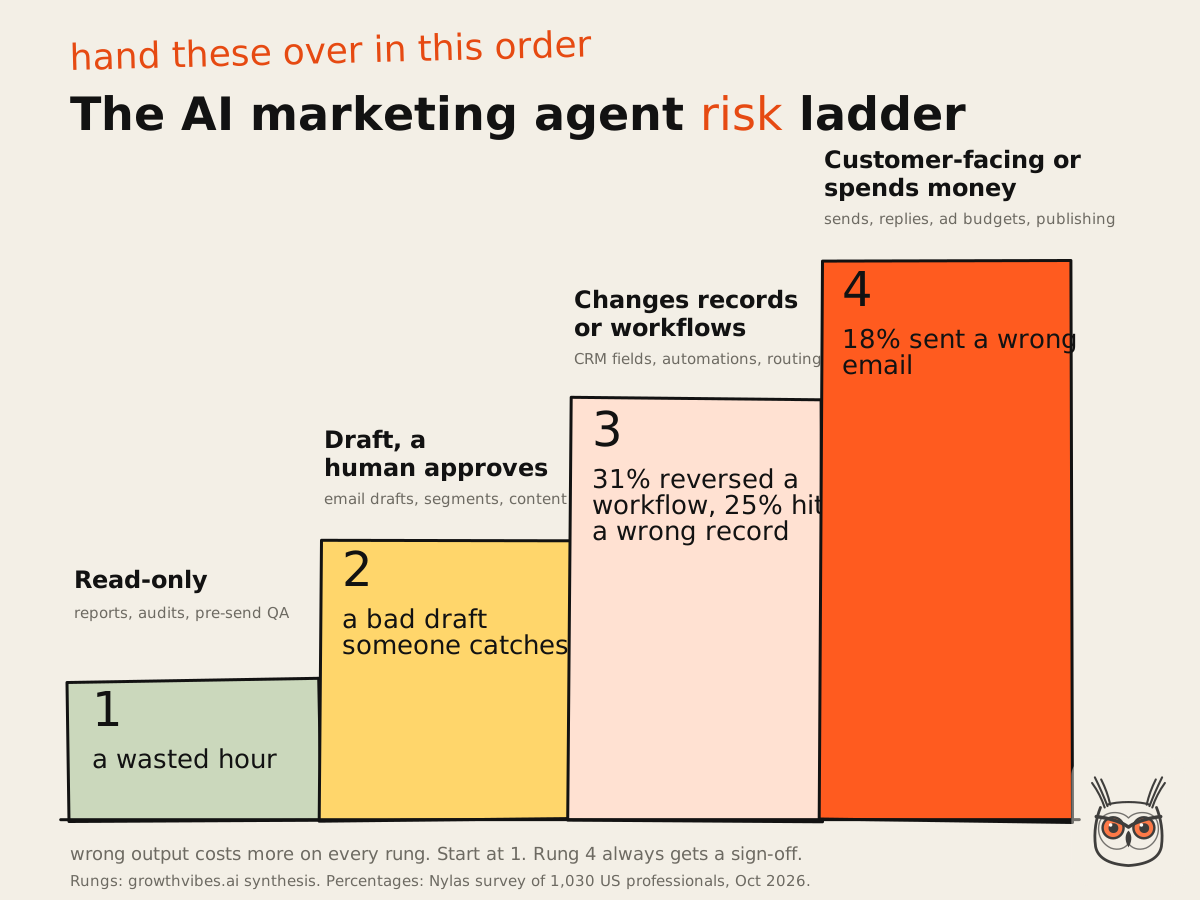
None of the ranking pages for this topic rank jobs by risk; they rank vendors. So here's the ladder I use. The rungs are my judgment, built from the vendors' own approval rules; the failure percentages are from a survey, which I'll get to.
| Rung | Jobs | If the agent gets it wrong | Sign-off rule |
|---|---|---|---|
| 1. Read-only | Performance reports, flow and segment audits, deliverability checks, pre-send QA | A wasted hour. Nothing leaves the building. | None needed. Spot-check weekly. |
| 2. Draft, human approves | Email and campaign drafts, segment proposals, content and SEO drafts, scheduled prep work | A bad draft a person catches, if a person looks | Every item, by someone who reads it |
| 3. Changes records or workflows | CRM field updates, triggering or editing automations, lead routing and scoring rules | Reversed workflows (31% of teams) and wrong records (25%) | Review before it runs, plus a way to undo |
| 4. Customer-facing or spends money | Sends without a gate, customer replies, ad budgets and bids, publishing | A customer sees it, a price is wrong, money is gone (18% sent a wrong email) | Always a human click. No exceptions yet. |
The skeptic's take comes with numbers. A Nylas survey of 1,030 US professionals, published 20 October 2026, found 54% had an AI agent make a mistake in the previous 90 days. 31% had one trigger a workflow the team had to reverse, 25% had one update the wrong record and 18% had one send an incorrect or inappropriate email. Two caveats, and they're big ones: Nylas sells email infrastructure for agents, and a third of the respondents work in engineering, not marketing. Still, the common failures are the boring ones, reversed workflows and wrong records, not the headline-grabbing rogue email.
There's a neat contradiction hiding in the forecasts, too. Gartner predicts that at least 15% of day-to-day work decisions will be made autonomously by 2028. Meanwhile the same Nylas survey says only 7.5% of teams let agents act with no human approval today (up from 4.2% in December 2025), and 30% still require approval on every action. They measure different things, a forecast of decisions versus today's approval policy, so they don't strictly clash. But if you want to know what teams actually do, the survey is the better guide. And the survey says: almost everyone keeps a hand on the brake.
Scale makes it worse, which nobody puts in the brochure. In that survey, 45% of companies running one to five agents had an incident, against 70% of those running more than 20. More agents, more surprises. Read first, write later.
So what stays with you? The practitioners on a busy r/DigitalMarketing thread in late October landed roughly where I would: execution gets automated, while customer psychology, goals, taste and judgment stay with people. One commenter made a sharper point about client communication: people can tell, and they read it as disrespect. I'd add one more to the keep pile: deciding what not to do. An agent will happily run every campaign you can describe. It will never tell you the campaign is a bad idea.
When I was the one-person marketing team at Wealthyhood, running strategy and execution across every channel, the thing I was short on wasn't drafts. It was hours for the reporting, QA and admin that ate the week before strategy could even start. That's the rung-one and rung-two work, and it's exactly what this generation of tools is good at.
If you'd rather have that set up properly than piece it together, it's the core of my AI automation and agents work.
How AI marketing agents go wrong, and the guardrails to set
AI marketing agents go wrong in three common ways: they reverse or trigger the wrong workflow, they write to the wrong record, and less often they send something a customer sees. Set four guardrails before an agent touches anything customer-facing: an approval step, a log you can read, a cap on turns or spend, and written rules.
The best-known incident this year wasn't even a marketing agent. In July 2026 Who Gives A Crap suspended an AI email agent after it confirmed to a customer that their subscription would go from 48 rolls at $66 to 24 rolls at $69.50, repeating a typo from an earlier email. The company shut the agent down and sent a correction. It was a customer-service agent, but the shape is the one to fear in marketing: a confident, polite, wrong message about money, sent to a real customer.
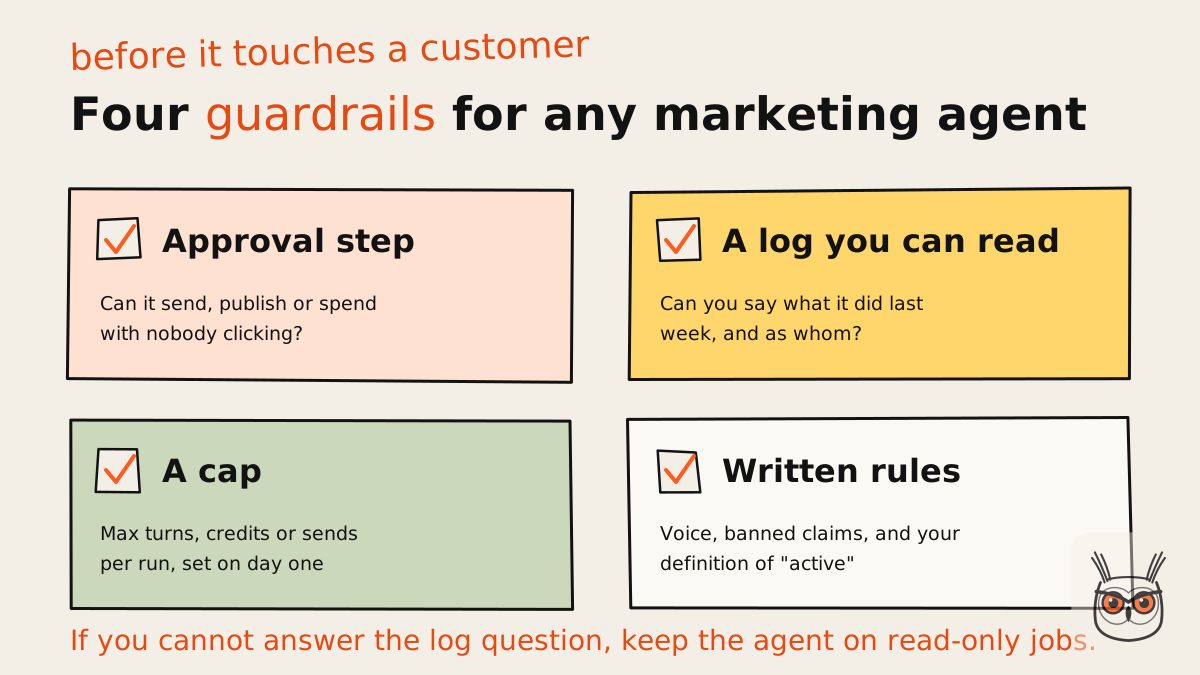
Here are the four, and the question that tests each one:
- An approval step. Can the agent send, publish or spend with nobody clicking? If yes, move that action back to draft. Klaviyo and Lindy both ship this by default, which tells you what they think of the alternative.
- A log you can read. Can you say what the agent did last week, and under whose name? Only 53% of teams in the Nylas survey can fully audit that. Where agents had their own identity, 66% could; where they acted through an employee's account, 51%. Give the agent its own login. It's the cheapest fix on this list.
- A cap. A maximum number of turns, credits or sends per run. Anthropic warns that autonomy means higher costs and errors that compound, and recommends stopping conditions like a maximum number of iterations. Lindy pauses when credits run out rather than billing more, which I'd call a feature.
- Written rules. Brand voice, banned phrases, compliance text and your own definitions, written into the tool, not living in your head. Klaviyo's guide suggests a line like "don't invent a discount, deadline or product benefit", and I'd put that one in every marketing agent I touch.
Now the part I find more interesting than any incident. The approval gate is both the safety feature and the reason these tools fail Forrester's autonomy test. The definition fight in the first section and the guardrails in this one are the same argument. Vendors want the word "autonomous" on the box and the approval button in the product, and right now the button is winning. Good.
The gate has its own failure mode, though, and I've seen it play out: approval fatigue. A team I worked with approved agent drafts so reliably that after a few weeks the "review" was a thumb hovering over the button. Forty approvals in a row, not one edit. At that point you don't have a human in the loop. You have a human-shaped delay.
One more for the skeptic's file: the "84% faster" stat you'll see quoted in agent articles. I traced it to three different claims. Blueshift reports its own planning tool as 84% faster than manual, an aggregator chain uses the same figure for content delivery, and Klaviyo uses it for query resolution. Three vendors, three tasks, one suspiciously round number, and no independent test behind any of them that I could find. I only found vendor and aggregator sources for it, so treat it as marketing about marketing.
The bigger gap is that nobody publishes the measured accuracy of a marketing agent on a named task. Not the vendors, not the analysts. Until someone does, the risk ladder is the most honest framework available: assume it will be wrong sometimes and decide in advance how much a wrong answer is allowed to cost.
Can I create AI agents for marketing?
Yes. You can buy a native agent inside a platform you already pay for, like Klaviyo Composer for email or HubSpot's agents for CRM work, or build your own with a no-code builder such as Zapier Agents, Lindy or n8n. Buy when the job lives in one tool. Build when it crosses several.
If you can write a checklist for a new teammate, you can write a skill: that's close to how Klaviyo pitches it, and it's roughly true. A Composer skill is a name, a description and plain-language instructions. Zapier's FAQ answers "do I need to know how to code?" with a flat no. The hard part was never the code; it's writing down how your team actually does the job.
Buy: native agents in the suite you already use
The native route wins when the data and the action live in one place. Klaviyo Composer for email and SMS, HubSpot's agents (Content, Nurture, Prospecting, Customer, plus a builder for custom ones) for CRM-centred work, Salesforce Agentforce if you're already deep in Salesforce. The upside is access: the agent sees your real segments, your real deals, your real history. The downside is lock-in, and native credits can cost more per job than a builder. Platform partners also tend to keep everything inside the platform, even when a cheaper cross-tool workflow would do.
If the job you care about is sales, I ranked nine of those tools by what they do and what a qualified lead costs in AI sales agents: the ones worth using.
Build: no-code and open-source builders
The build route wins when the job crosses tools: pull from analytics, check the CRM, write to a doc, ping Slack. The builders I'd look at, by how they charge (prices as of 5 November 2026):
- Zapier Agents: free for 400 activities a month; Pro is $33.33 a month (billed annually) for 1,500. Zaps run on a separate task-based plan from $19.99 a month. Pricing.
- Lindy: Team plan from $29.99 a month for 3,000 credits, top-ups at $10 per 1,000, every active user billed, approvals built in, 1,500+ integrations. Pricing.
- n8n: Starter is $20 a month for 2,500 executions; the AI Agent node is free but the model's tokens are billed separately. Self-hostable if you have someone who likes servers. Pricing, checked 4 November 2026.
- Relevance AI: only an Enterprise tier on the pricing page, with a "talk to sales" button. You know what that means.
My rule of thumb: if the agent's whole job lives inside one platform, buy the native one or hire a partner certified on it. If it spans tools, build. I wrote a separate, step-by-step guide on how to build AI agents from first prompt to production, so I won't repeat the how here.
For what it's worth, my own setup is the build route. The SEO content automation I built runs as a chain of skills and scripts with a person checking before anything publishes, which is rung two of the ladder wearing a hard hat. It's the boring version of an agent, and the boring version is the one I trust.
What AI marketing agents cost
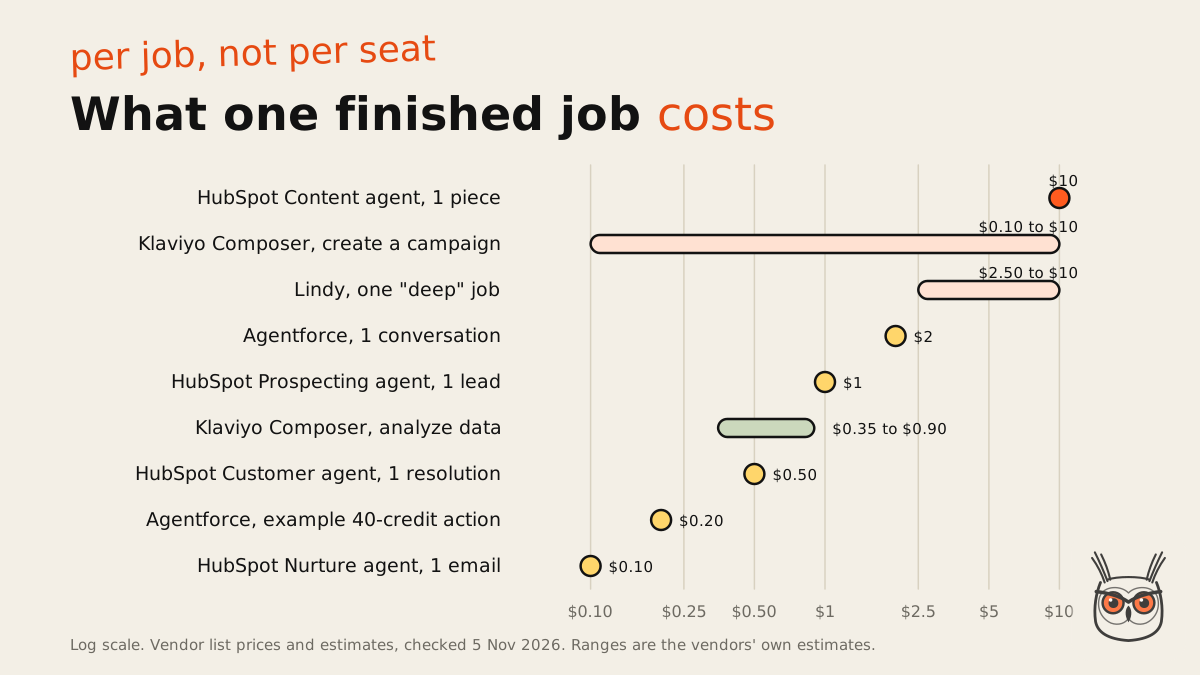
AI marketing agents are sold on different meters: credits, outcomes, activities, tasks and seats, so sticker prices don't compare. Per finished job, prices checked on 5 November 2026 run from about $0.10 for a HubSpot nurture email to $10 for one HubSpot content piece. A real job usually costs dollars, not cents.
The cost view is the one most guides skip, so here it is per job rather than per seat:
| Vendor | Meter | Unit price | Example jobs (vendor figures) |
|---|---|---|---|
| HubSpot | Credits | $0.01 per credit ($10 per 1,000) | Content piece $10, recommended lead $1, resolution $0.50, nurture email $0.10 |
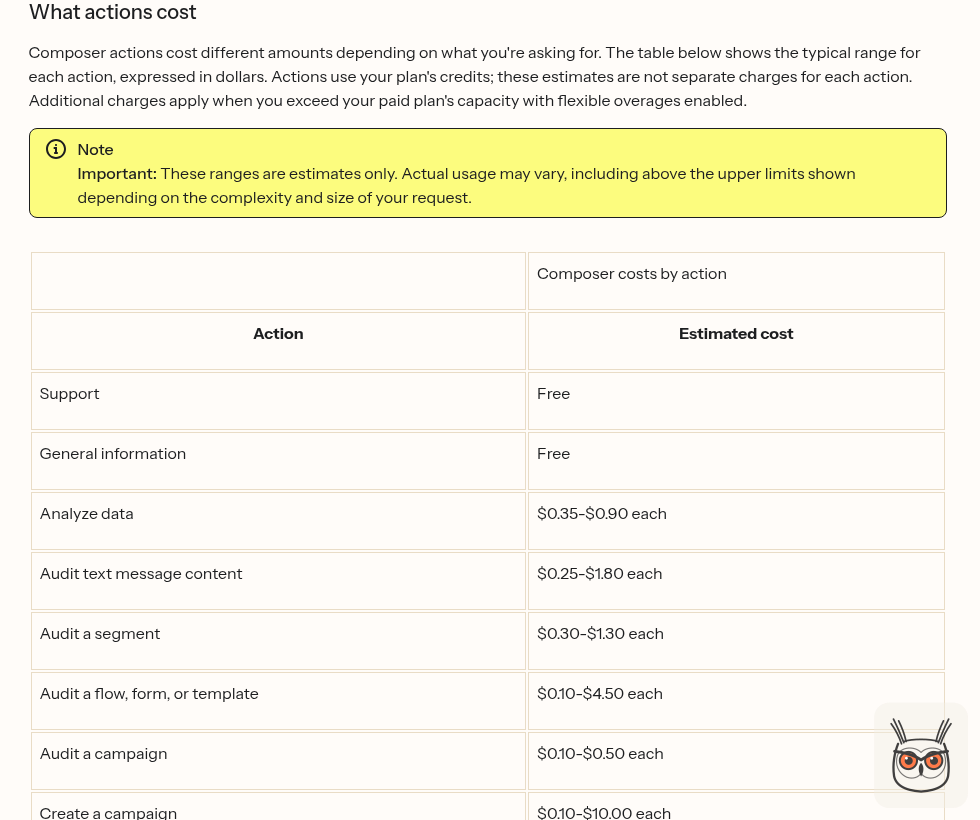
| Klaviyo Composer | Credits | Free: 500 credits; $20 a month: 2,000 | Create a campaign $0.10 to $10, analyse data $0.35 to $0.90, audit a campaign $0.10 to $0.50 (estimates) |
| Salesforce Agentforce | Flex Credits, conversations | $500 per 100,000 credits ($0.005 each) | Example 40-credit action $0.20, conversation $2; add-on $125 per user a month |
| Zapier Agents | Activities | About $0.022 per activity on Pro | No per-job examples published |
| Lindy | Credits | About $0.01 per credit | A "deep" job of 250 to 1,000 credits: $2.50 to $10 |
| Relevance AI | Not public | Enterprise only | Talk to sales |
A few things jump out. HubSpot and Salesforce conversations bill per outcome, which quietly moves the risk of a bad run onto the vendor: you pay for a resolution or a recommended lead, not for every attempt. Credits and activities leave that risk with you: if the agent takes six goes, you pay for six goes. That difference matters more than any headline price.

Klaviyo is the honest one about uncertainty, in a slightly alarming way. Its help page lists estimated costs per action, and says no exact cost is shown before an action runs and real usage can land above the top of the range. "Create a campaign: $0.10 to $10.00." That's a 100x spread, which is less a price and more a weather forecast.
Two price traps from this round. You'll find an older Klaviyo help article quoting 2,000 credits for $14 a month; it labels itself legacy, introductory pricing, and the current plan is $20 a month for 2,000. And a few comparison articles still quote "Agentforce 1 Edition from $550"; the Salesforce page, modified 19 October 2026, now calls it Max Edition, from $550 per user per month, and says the page is subject to change. Date-stamp every agent price you put in a budget. They move faster than the agents.
The real bill is rarely the platform anyway. A single AI workflow usually costs tens of dollars a month to run; the expensive part is the person who maintains it, fixes it on a Tuesday and rewrites the rules when your offer changes. Budget for that person first.
How to start with one AI marketing agent
Start with one read-only job, such as a weekly performance brief or a pre-send audit. Write down the success metric before you switch it on, run the agent beside the human version for a month, compare the two, and only then move it to drafts. One job, one owner, one metric, one month.
One forecast worth keeping in mind: over 40% of agent projects cancelled by the end of 2027 on rising costs, unclear value or weak risk controls (Gartner, June 2025). It's a prediction, not a measurement, and some of those cancellations will be healthy pruning. But "unclear value" is the one you control, and it almost always means nobody agreed what success looked like before the pilot started.
Pick one read-only job
A Monday performance brief, a flow audit or a pre-send QA pass. Something you already do by hand, so you have a baseline.
Write the success metric first
Hours saved, issues caught before send, or time to the Monday decision. One number, written down before the agent runs.
Give it your rules and definitions
Brand kit, banned claims, real past briefs and what "active" means in your account. This is the first hour, and it is the hour that matters.
Run it beside the human version for a month
Same job, both ways. Compare what each one caught, missed and got wrong.
Promote it one rung at a time
Only then let it draft. Record changes come later, and rung four needs a sign-off forever, or at least until someone publishes accuracy numbers.
I know some people will say a reporting agent is a boring first project, and the boss wants to see output. Fair. A reporting agent saves less visible time than a content agent, so it's a harder sell. But it's also the one that can't embarrass you in front of a customer, and it teaches the team how the agent fails before the failures cost anything. Read first, write later.
The scoring I use to pick that first job is in AI for business automation.
The first agent you ship should be boring. Exciting is what you call it after it's run for a month without anyone noticing.
So, should you hire an agent or another marketer?
Remember the very fast intern who isn't allowed to touch the send button? That's the honest job description, and it's a good one. An AI marketing agent today can take the reporting, QA and drafting load of a small team off one person. It can't decide what to send, to whom or why, and nothing I found suggests that changes this year.
So hire the intern, give it the boring work and keep the button. If you want help setting that up, it's what my AI automation and agents work is for, and the rest of this site is me writing down what I learn doing it.
Frequently asked questions
What is an AI marketing agent?
An AI marketing agent is software that takes a marketing goal, picks its own next steps and uses your tools to get it done, usually stopping for your approval before anything goes out. Unlike an assistant, it doesn't just answer one prompt.
Most products sold as marketing agents today are workflows with a model step and a human approval. That's fine for most teams: judge the tool by what it's allowed to do on its own, not by the label.
Can I create AI agents for marketing?
Yes. Use the native agent inside a platform you already pay for, like Klaviyo Composer or HubSpot's agents, or build one with a no-code builder such as Zapier Agents, Lindy or n8n. You don't need to code.
Buy native when the job lives inside one platform; build when it crosses several tools. For the build itself, see the step-by-step guide on how to build AI agents.
What are the leading AI agent builders for marketing?
For no-code builds, Zapier Agents, Lindy and n8n are the common picks; Relevance AI sells mainly to enterprises. For native agents, Klaviyo Composer covers email and SMS, HubSpot covers CRM work and Salesforce Agentforce suits Salesforce shops.
Pick by where your data lives and how each one charges: activities, credits, executions or outcomes. Prices change often, so check the pricing page on the day you decide.
How much do AI marketing agents cost?
As of 5 November 2026, from about $0.10 per job (a HubSpot nurture email) to $10 (a HubSpot content piece), with entry plans around $20 to $34 a month for Klaviyo Composer, Lindy and Zapier Agents. Real jobs usually cost dollars.
Compare per finished job, not per seat, and remember that credit and activity meters charge you for retries while outcome pricing does not.
Can AI agents replace my marketing team?
No. They can take over a lot of execution, like reports, audits, QA and first drafts, but strategy, audiences, definitions and the final send still need people. Only 7.5% of teams in a 2026 survey let agents act with no approval.
Today's models still struggle to pursue a complex business goal on their own over weeks, and nobody publishes accuracy numbers for marketing agents yet. What agents can do is let one marketer cover the workload of a small team.
What happens when an AI agent makes a mistake?
You reverse the workflow, fix the record or correct the message, which is why approvals and logs matter before launch. In a 2026 survey, 31% of teams had reversed an agent's workflow and 18% had one send a wrong email.
Plan the undo before you need it: give the agent its own account, keep a readable log, and write down who fixes what. When Who Gives A Crap's email agent confirmed a wrong price, the company shut it down and sent a correction.
