
An AI sales agent is software that does a slice of sales development on its own: it answers or contacts leads, asks the qualifying questions, books the meeting and writes the result into your CRM. The ones worth paying for in November 2026 split by job. Fin for Sales and Qualified for inbound, Amplemarket if you want outbound with a human approving, 11x if you want outbound with nobody approving (and $36,000 a year to spare), and Agentforce if you already live in Salesforce.
Every list I found for this topic was written by a vendor, and every vendor ranked itself first. Which is efficient, I suppose. Nobody has to wait for the results.
So here is the ranking from someone with nothing to sell you on this page, except, fine, the occasional mention that I build AI automation and agents for marketing and sales teams. For each tool you get who it's for, the price as the vendor's own page showed it on 13 November 2026, where it breaks and who should skip it. Then a build-or-buy section with real numbers and a six-step setup with the failure points the demos leave out.
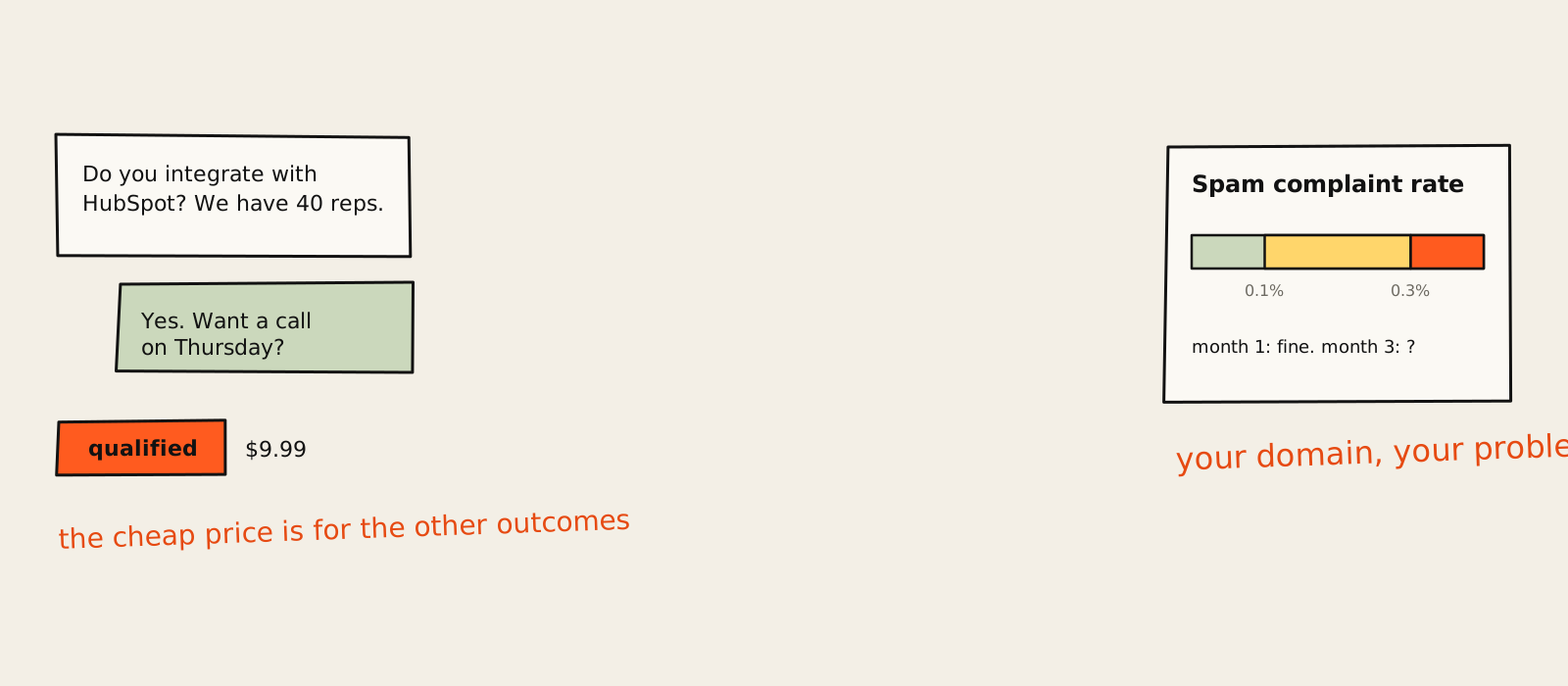
One thing to keep an eye on as you read: the cheapest number on this whole page is $0.99. It is also the most misleading one. The house rule, which you'll hear again before the end: price the qualified lead, not the chat.
What is an AI sales agent (and how is it different from a chatbot)?
An AI sales agent is software that runs part of the sales process without a person driving each step: it talks to leads or writes to prospects, qualifies them, books meetings and updates the CRM. A chatbot follows a script and stops when the script runs out. An agent decides the next step and takes it.
That's the textbook version, and if you want the general idea of agents first, I wrote a plain explanation of AI agents that covers it. In sales the textbook version breaks the moment you read three vendor pages back to back, because each vendor draws the line somewhere else.
- Fin draws it by scope. It calls its product an AI sales agent that runs inbound sales conversations end to end, and says people call the category "AI SDR" because it does an inbound SDR's work.
- Salesforce draws it by autonomy. An AI sales agent understands an inquiry and then takes action without human intervention; chatbots, in its telling, relied on scripts.
- SalesCloser draws it by channel. "AI SDRs send emails to cold lists", it says; its own agents have live conversations by phone, chat and video with leads who already reached out.
Three companies, three definitions, one label. (The label is doing a lot of unpaid overtime.) So I'd skip the feature checklist and define an AI sales agent by the job it owns and the channel it works in: an inbound conversation on your site, outbound email to people who never asked, or a copilot that does the CRM paperwork for your reps. Ask a vendor which of those three jobs its agent owns before you ask what model it uses. The answer tells you more than the demo.
What an AI sales agent can do (and what the brochures skip)
An AI sales agent can qualify inbound leads in chat, email prospects, book meetings, draft follow-ups and update opportunity fields in the CRM. What it can't do varies a lot by product, and the gaps sit in the FAQ, not on the homepage. Read the "does not" list before the "does" list, because that is where the real differences are.
Every capability list on the internet reads the same: qualifies leads, books meetings, follows up, updates the CRM, forecasts. It's the sales-tool version of a dating profile that says "loves travel". The official pages, read slowly, tell a less uniform story:
- Fin books meetings but doesn't chase. It books through Calendly or Chili Piper, and its own FAQ says it does not support automated email follow-up sequences after qualification. A lead who goes quiet stays quiet unless something else picks them up.
- Salesforce lets you choose how brave to be. Its opportunity-update agent runs in autonomous mode or suggestive mode, where a rep reviews and approves each change. That switch is the most useful feature on the page and nobody leads with it.
- Artisan emails, your reps dial. Its pricing page puts it in four words: "Ava emails, your reps dial." Calls come with a brief before and a follow-up after, but the voice is human.
- SalesCloser talks, it doesn't cold email. It works the leads already reaching out to you, by phone, chat and video.
If you've been through where AI agents earn their keep in a business, this will look familiar: the useful agents do one job well and hand everything else to a person. The "does not" list is the spec. Write it down for every tool on your shortlist, because it's the list that decides what you still have to build or staff around the agent.
How to choose an AI sales agent: inbound, outbound or ecommerce
Choose an AI sales agent by the job first: inbound qualification for people who came to you, outbound prospecting for people who didn't, CRM work for your reps, or selling inside an ecommerce support chat. For most SaaS teams under 10 reps, start with inbound. It is cheaper, starts with a trial and can't burn your sending domain.
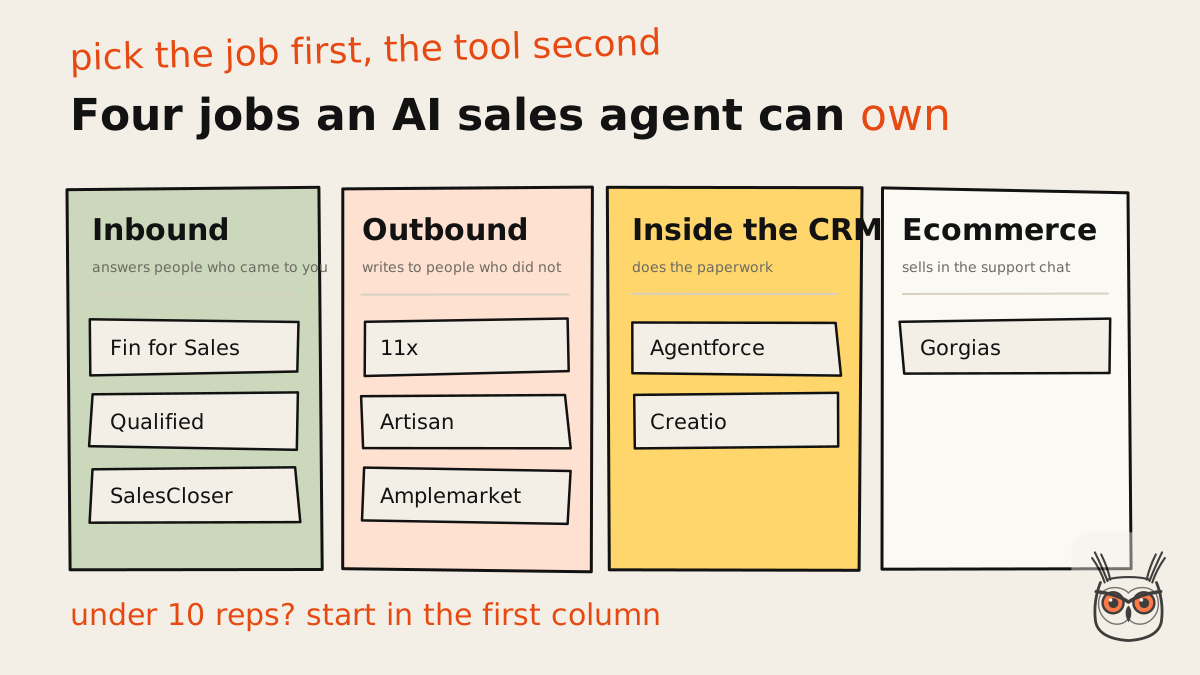
That "under 10 reps" line is my position, and I'll defend it. The inbound tools on this list price per outcome or per conversation and let you start with a trial. The outbound tools that publish a price want an annual contract from $7,200 to $36,000, and they send email in your name, from your domains, to people who never asked. If outbound goes wrong, it goes wrong in public. If inbound goes wrong, a visitor gets a clumsy answer and a human follows up. I know which one I'd rather explain to a CEO.
The exception is obvious: a team with no inbound traffic has nothing to qualify. Then outbound is the only game, and the question becomes how much autonomy you want. If that's you, my guide to AI marketing agents covers the outbound-adjacent jobs (lead scoring, list research, drafts) that are safer to hand over first.
The cost view: five vendors, five different meters
Here's the part no ranking page puts side by side. Every vendor bills a different unit: per outcome, per conversation, per action, per lead volume, per seat, or "let's get on a call". The table below is the list price from each vendor's own page on the date shown. Prices change, so check before you sign.
| Tool | Job | What you pay for | List price (dated) | Term |
|---|---|---|---|---|
| Fin for Sales | Inbound | Per outcome | $0.99 per resolution or handoff, $9.99 per qualification (13 Nov 2026) | 14-day trial, no card |
| Agentforce | In the CRM | Per conversation or per action | $2 per conversation, or $0.10 per action on Flex Credits (19 Oct 2026) | Quote; credits do not roll over |
| Creatio | In the CRM | Configured bundle | Not published (13 Nov 2026) | Configurator and demo |
| 11x | Outbound | Per lead volume | Growth from $36,000 a year (12 Nov 2026) | Annual |
| Artisan | Outbound | Plan by leads contacted | Not published (13 Nov 2026) | Quote |
| Qualified | Inbound | Web sessions and email contacts | Not published (13 Nov 2026) | Quote |
| Amplemarket | Outbound, copilot | Plan with seats | Startup $600 a month (13 Nov 2026) | Annual, free trial |
| SalesCloser | Inbound, voice | Quote | Not published (12 Nov 2026) | Priced on a call |
| Gorgias | Ecommerce | Per resolved interaction | AI Agent from $27 a month, then per interaction (13 Nov 2026) | Monthly or annual |
Different meters make the cheap-looking price a trap. So I ran one labelled example: 500 inbound conversations a month, of which 100 turn into qualifications. The mix and the four actions per conversation are my assumptions, not a benchmark.
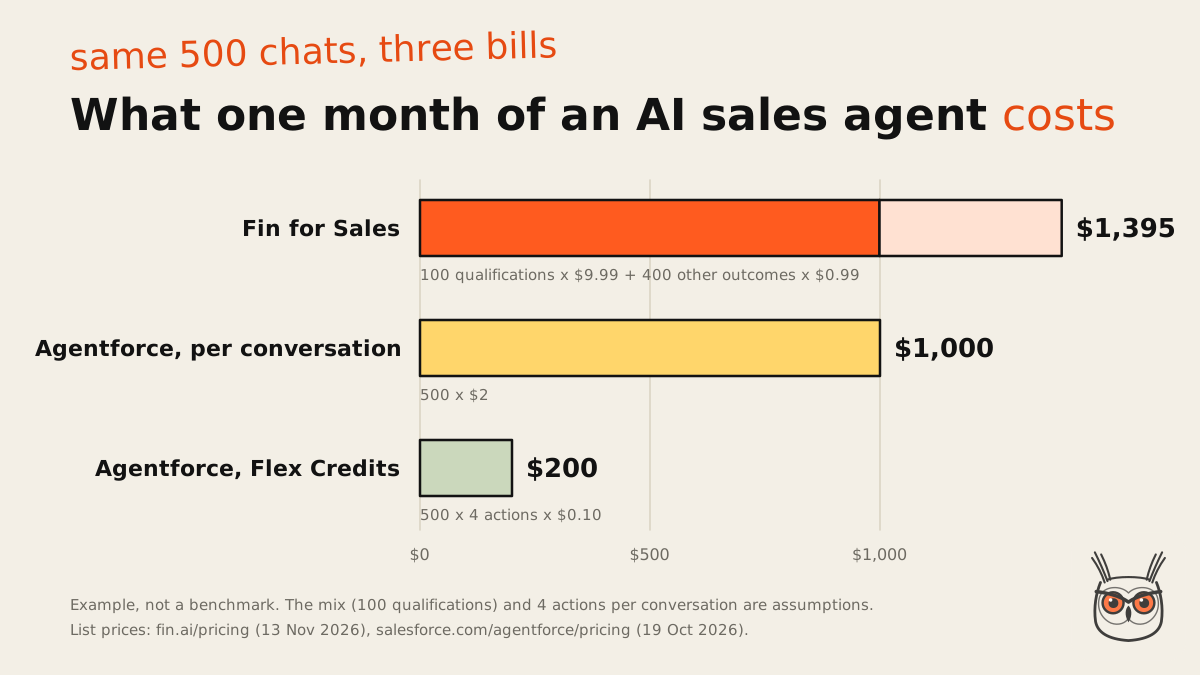
Fin's headline is $0.99, Agentforce's is $2, and Fin still comes out the most expensive of the three in this example, because the qualification is the outcome you actually want, and it's the one that costs $9.99. Change the mix and the ranking moves. That's the whole point: before any demo, work out cost per qualified lead for each tool on your shortlist. Price the qualified lead, not the chat.
1. Fin for Sales: best for inbound qualification and support in one chat
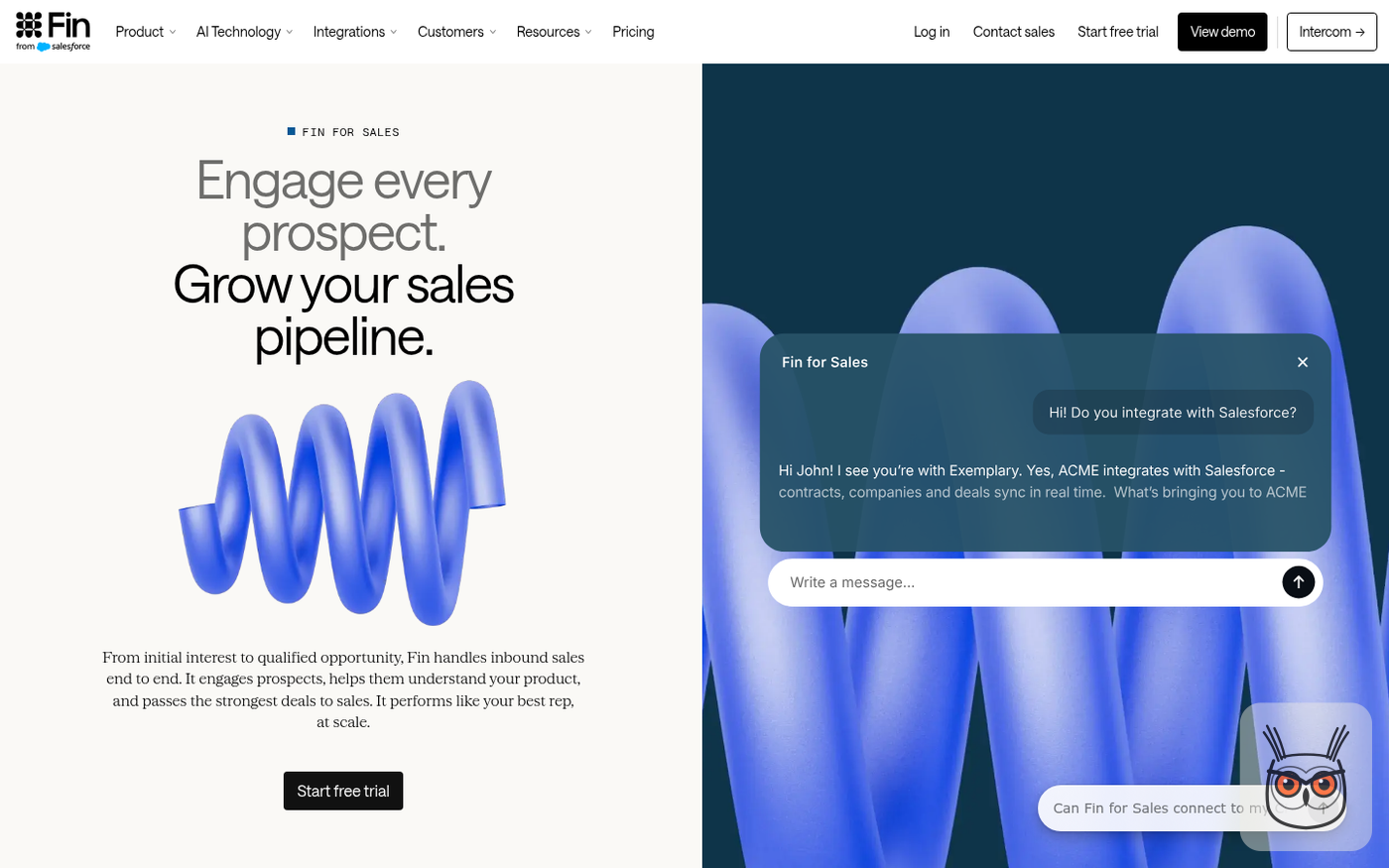
Fin for Sales is the one I'd start with if inbound leads already land in Intercom or another helpdesk. It qualifies in the chat that answers support questions, routes good leads to sales and syncs to your CRM. Verdict: the best first AI sales agent for a SaaS team with traffic, as long as you budget for qualifications, not resolutions.
- Best for: inbound qualification and support in one chat, for teams already on Intercom or another helpdesk.
- Pricing (13 Nov 2026): $0.99 per resolution, handoff, disqualification or self-serve routing; $9.99 per qualification; 50 outcomes a month minimum on non-Intercom helpdesks; 14-day free trial. See the Fin pricing page.
- Where it breaks: no automated email follow-up sequences after qualification, and Calendly booking needs a paid Calendly plan (it shows the next two weeks).
- Skip it if: you need outbound prospecting. It handles inbound only.
- CRM integrations: Salesforce, HubSpot, Marketo and Chili Piper; qualification data syncs to the CRM.
- Channels: Messenger, email, voice, Slack, WhatsApp, SMS, Instagram and Facebook Messenger. Voice is custom-priced.
- What users say: the customer story on the page is Brightwheel, which says Fin handled more than 4,000 merchant conversations in 60 days and closed more than 70 deals. Vendor-published, so read it as the best case.
- The cost view: the $0.99 everyone quotes is the cheap outcome. The one you bought the tool for is ten times that.
I like Fin's design more than its pricing page wants me to. Support and sales in the same chat is how buyers actually behave: they ask whether you integrate with Salesforce, then whether you have SSO, then what it costs. One agent answering all three is better than three widgets fighting for the corner of your screen. You're not charged when a conversation is simply passed to your team without an outcome, which is fair.
The contradiction is the price. Roundups quote "from $0.99 per outcome" and stop there. The pricing FAQ puts qualifications at $9.99, and both numbers are true. Go in knowing which one your volume will be made of, and plug the follow-up gap with your own sequence tool, or leads that go quiet after qualifying will stay that way.
2. Salesforce Agentforce SDR: best for teams that already live in Salesforce
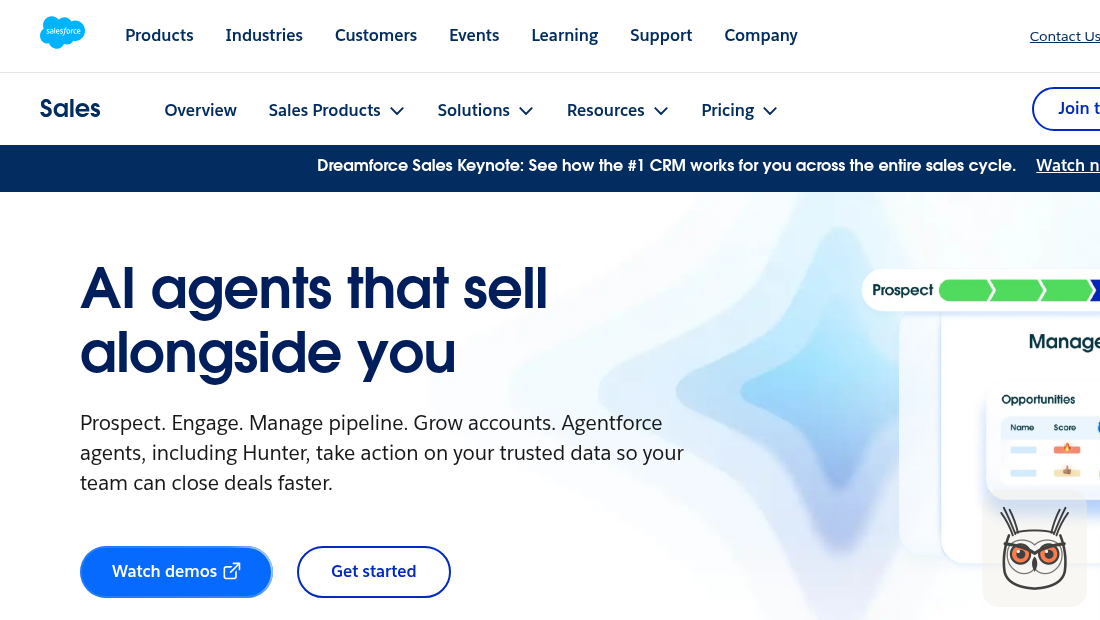
Salesforce Agentforce is the AI sales agent for teams whose pipeline, data and habits already sit in Salesforce. It works inside the CRM, can update opportunities on its own or wait for a rep's approval, and bills per conversation or per action. Verdict: a sensible pick for Salesforce shops, and a very expensive way to start for everyone else.
- Best for: teams already on Salesforce that want the agent inside the CRM rather than bolted on.
- Pricing (19 Oct 2026): $2 per conversation, or Flex Credits at $500 per 100,000 ($0.10 per standard action, $0.15 per voice action). An org can't use both models. See Agentforce pricing.
- Where it breaks: unused Flex Credits don't roll over into the next term; going over has no penalty but bills at your rate monthly in arrears; detailed pricing means talking to a rep.
- Skip it if: you're not on Salesforce. The pitch is that the agent is built into Salesforce CRM, Data 360 and its trust layer.
- CRM integrations: native to Salesforce CRM and Data 360, plus Slack. The Trailhead setup module is the honest place to see what configuration involves.
- Channels: website, email and Slack; voice through Agentforce Voice.
- The skeptic's take: for a team not already on Salesforce, the CRM is the real price, not the $2.
- The cost view: credits that expire at the end of the term reward people who forecast usage well, which is nobody in month one.
- What changed: the AI sales agent page was updated on 30 October 2026 and the pricing page on 19 October 2026, so roundups from the summer are already stale.
Salesforce's argument is that agents built into the CRM beat agents connected to it, and for a Salesforce shop that's mostly true: fewer sync jobs, fewer permission puzzles, one place to look when something odd happens. The suggestive mode, where a rep approves each opportunity update, is the setting I'd turn on first and leave on until the change log gets boring.
For anyone else, it's like buying a house to get the garden. Salesforce Foundations gives you a free start on the Agentforce builder, which helps, but the agent doesn't fix the cost of moving your CRM. If you're on HubSpot or Pipedrive, look further down this list.
3. Creatio: best for CRM-native agents with governance
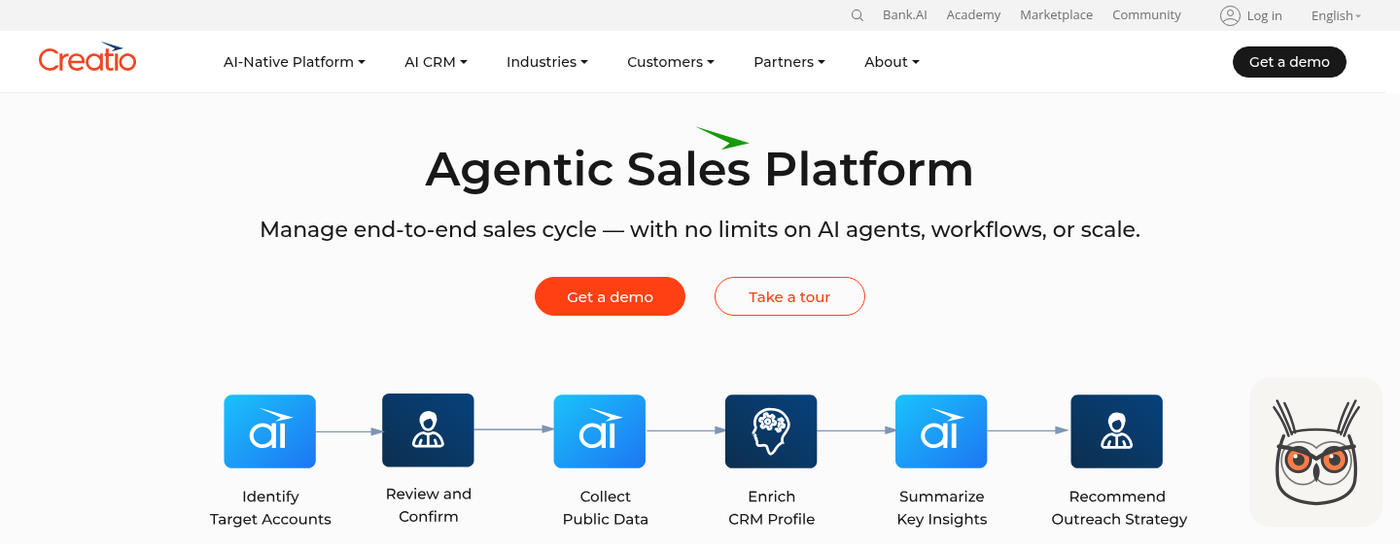
Creatio is a CRM with sales agents built in, not a drop-in SDR. Its agents research accounts, generate quotes, prepare meetings, forecast, score leads and update CRM data for your reps. Verdict: worth a look if you're choosing a CRM anyway and want governed agents inside it; the wrong tool if you want an agent to talk to leads.
- Best for: teams that want a CRM with governed AI agents inside it, and are open to switching CRM to get them.
- Pricing (13 Nov 2026): a configurator, not a price list. AI capabilities are included at no additional cost, per the product page. Build a quote on the Creatio pricing page.
- Where it breaks: I found no independent failure reports for Creatio's sales agents, which is either good news or a sign that few people write about it.
- Skip it if: you want a standalone agent for inbound chat or outbound email. The agents on the product page face your team, not your buyers.
- CRM integrations: it is the CRM, with a marketplace for your other tools.
- Channels: Microsoft Teams and Outlook agents; the page mentions AI-run outreach across channels without naming them.
- The skeptic's take: listed next to AI SDRs in every roundup, yet nothing on the product page is an SDR.
I went through the product page and counted: account research, quote generation, meeting preparation, forecast, territory management, next best step, order fulfilment, CRM data update and lead scoring. Nine agents, and every one of them works for your reps, not your prospects. That's not a criticism. It's the paperwork half of sales, and the paperwork is where a lot of rep hours quietly go.
It ranks third because most readers of a list like this want an agent that talks to buyers, and Creatio doesn't sell that. If you're already shopping for a CRM, though, "AI at no additional cost" beats a second contract for a bolt-on.
4. 11x: best for fully autonomous outbound
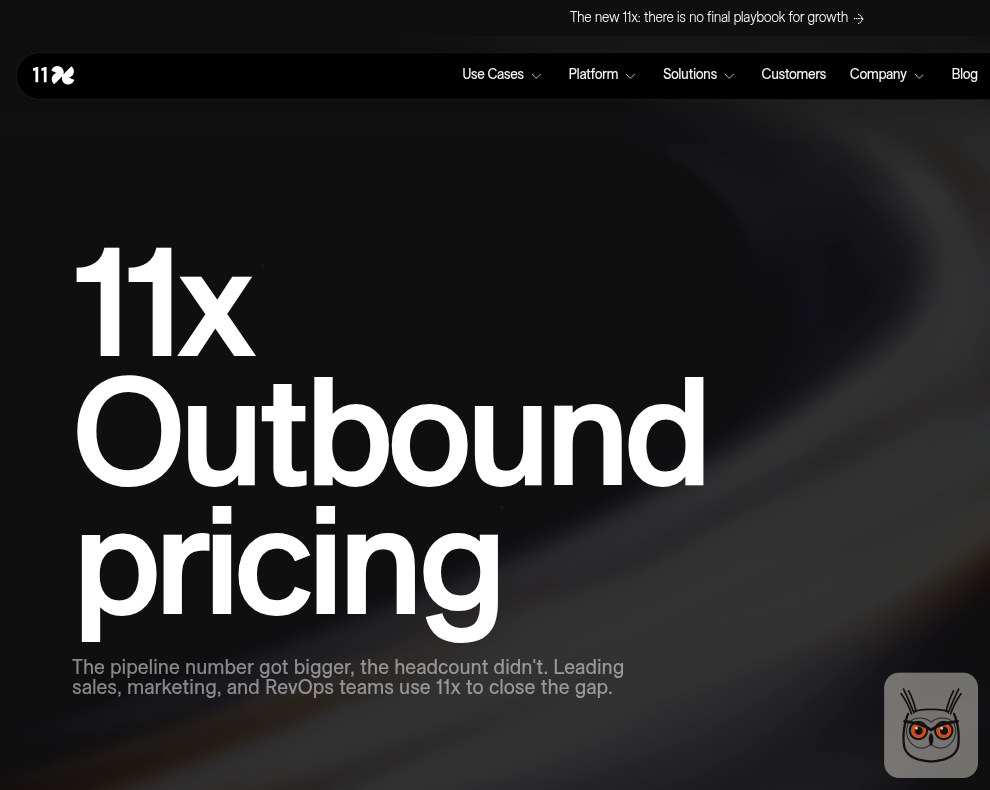
11x sells Alice, an AI SDR that runs outbound on its own: finds prospects, writes and sends the emails, follows up and books meetings, with sending mailboxes, warmup and CRM sync included. Verdict: the most complete autonomous outbound package on this list, priced like a hire, and only for teams that can sign a year and absorb a weak pilot.
- Best for: fully autonomous outbound for teams that can fund an annual contract.
- Pricing (12 Nov 2026): Growth from $36,000 a year, billed annually, for up to 5 users and 2,000 new prospects a month; Pro and Enterprise are custom. Priced per lead, not per send. See 11x pricing.
- Where it breaks: reviewers report weak targeting and generic messaging; that's user reviews, not a measured result.
- Skip it if: you can't commit to a year. Annual is the default, and Pro and Enterprise go to two- and three-year terms.
- CRM integrations: two-way CRM sync on every plan; you bring your own CRM licence.
- Channels: email and social for outbound, with meeting booking; voice and chat sit in a separate inbound product.
- The skeptic's take: one buyer on Trustpilot says they put $9,000 into the tool and about $3,000 of staff time, then declined to extend. One review, but it's the shape of the risk.
- The cost view: third-party reviews quote $3,750 a month or about $5,000 a month for the same product. The official page says $36,000 a year, which is $3,000 a month.
- What changed: 11x now publishes a starting price at all, which most AI SDR vendors still don't.
11x bundles the part of outbound that actually breaks: managed mailboxes, warmup and deliverability. That's the hidden connection in this whole category, and one I keep coming back to on growthvibes.ai. The tools that include sending infrastructure cost the most; the ones that skip it leave the reputation risk with you. $36,000 buys you someone else's problem, which is sometimes a bargain.
The 11x FAQ compares Growth with a fully loaded SDR at $8,000 to $12,000 a month. That's a vendor comparing itself to a salary, so treat it as marketing, not maths. And with three different prices floating around the web, ask for the signed price for your volume in writing. An annual term turns a bad pilot into a sunk cost, so I'd only go here after an inbound agent or a copilot has proven your messaging works.
5. Artisan: best for outbound with a named AI SDR
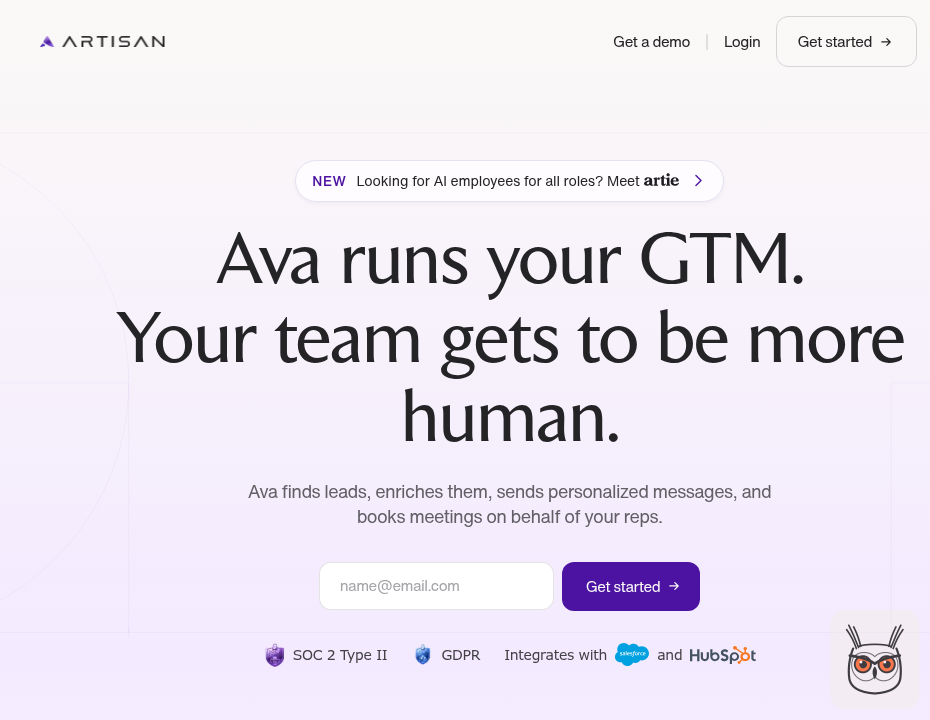
Artisan sells Ava, an AI BDR that finds leads, enriches them, writes personalised emails and books meetings for your reps, with a hands-on rollout. You can require approval before anything is sent. Verdict: a reasonable autonomous outbound option if you want help setting it up, but it publishes no price, so you negotiate blind.
- Best for: outbound with a named AI BDR that books meetings for reps, with white-glove rollout.
- Pricing (13 Nov 2026): not published. Plans are sized by leads contacted (Team about 2,500 a month, Scale about 6,000, Enterprise custom), and on the Artisan pricing page pricing is "scoped on your plan".
- Where it breaks: a few reviewers report rigid annual contracts; and Ava sends in your reps' names from your own sending domains, so its mistakes land on your reputation.
- Skip it if: you need the agent itself on the phone. Ava emails and your reps dial; the dialer is a per-seat add-on.
- CRM integrations: two-way sync with Salesforce and HubSpot, plus webhooks and Slack.
- Channels: autonomous email; a dialer for reps as an add-on.
- The cost view: third-party estimates of Artisan's price disagree with each other by more than three times. I wouldn't trust any of them, and you shouldn't quote one in a budget.
Artisan's best feature is buried in a bullet: you can require approval before Ava sends. Turn it on. It's the difference between an AI SDR and an AI that sends emails while you're at lunch.
The thing nobody writes about is the domain. Ava sends from your domains, in your reps' names. If the agent's sending pattern gets flagged, it's your domain that pays, and your human reps send from it too. I'll come back to that in the setup steps, because it's the risk I'd plan for before the contract, not after.
6. Qualified: best for high-intent website visitors
Qualified sells Piper, an AI SDR for your website: it talks to visitors by text, voice or video, qualifies them and books meetings. Plans are sized by web sessions and email contacts. Verdict: the strongest inbound pick for B2B companies with serious traffic and a Salesforce-centred stack; overkill for a small site.
- Best for: high-intent website visitors, with meeting booking, for teams built around Salesforce.
- Pricing (13 Nov 2026): not published. Three tiers (Premier, Enterprise, Ultimate) sized by monthly web sessions (250K, 2M, 5M) and active email contacts (2.5K, 10K, 25K). See the Qualified pricing page.
- Where it breaks: I found no independent failure reports for Piper.
- Skip it if: your site gets little traffic. The smallest plan is sized at 250K monthly web sessions.
- CRM integrations: Salesforce CRM plus 20+ go-to-market systems, with HubSpot, Marketo, Outreach and Salesloft among the logos.
- Channels: text, voice and video on the website, plus email; several languages.
- What changed: the logo on the home page now reads "from Salesforce", and Salesforce says it launched Piper as its own AI SDR in 30 days.
Review sites keep saying you need Salesforce to run Qualified. The official pricing page lists Salesforce plus 20+ other systems, HubSpot included, so I side with the page. Built around Salesforce, yes. Requires it, the evidence doesn't say. If you're on HubSpot, ask in the demo whether the HubSpot integration does everything the Salesforce one does, because that's the question nobody has answered in public.
The traffic floor is the real filter. 250K sessions a month is a lot of visitors for a SaaS company with ten reps, which is why I'd send most small teams to Fin first and come back to Qualified when the site has outgrown it.
7. Amplemarket: best for copilot-style outbound where reps keep approval
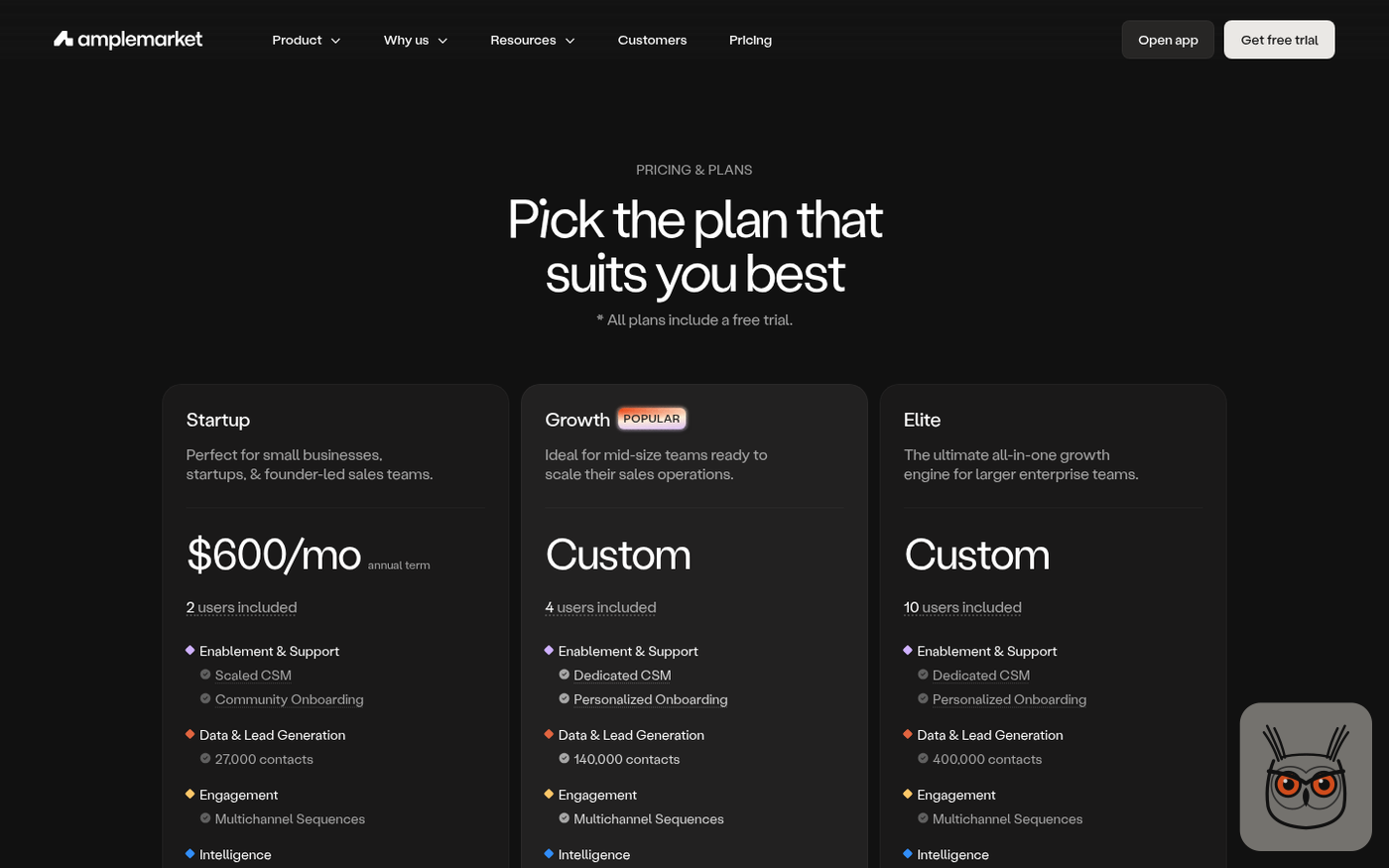
Amplemarket is an outbound platform with an AI copilot, Duo, that drafts and suggests while reps approve. It covers contact data, sequences and phone. Verdict: the cheapest published way to test AI-assisted outbound with a human approving every send, and the one I'd pick before any fully autonomous AI SDR.
- Best for: copilot-style outbound for small teams where reps keep approval.
- Pricing (13 Nov 2026): Startup is $600 a month on an annual term with 2 users; Growth (4 users) and Elite (10 users) are custom. Every plan has a free trial. See Amplemarket pricing.
- Where it breaks: the annual term, and seats. Third-party breakdowns say extra users run about $300 to $400 a month each; I couldn't confirm that on the official page.
- Skip it if: you want a hands-off agent. Reps approve what Duo drafts, which is the point.
- CRM integrations: CRM filters on every plan; a customer review on the pricing page praises the HubSpot integration.
- Channels: email and phone with verified numbers; Duo Voice on Growth and up; Duo Inbox, which drafts replies, on Elite.
- The cost view: $7,200 a year is the lowest published entry price for outbound on this list, a fifth of 11x Growth.
I like this design because a copilot fails quietly and an autonomous agent fails loudly. When Duo drafts a bad email, a rep deletes it and nobody outside the company ever knows. When an autonomous agent sends a bad email, 2,000 prospects know.
It's also the honest way to find out whether your outbound messaging works at all before you pay someone to automate it. Run the copilot for a quarter, measure replies, then decide whether autonomy is worth five times the price.
8. SalesCloser: best for phone, chat and video demos for small teams
SalesCloser answers inbound leads in seconds by phone, website chat or video, qualifies them and books meetings with your team. It can also run live demos on video. It doesn't do cold email. Verdict: the pick for small teams whose leads would rather talk than type, if you're fine with a price you only hear on a call.
- Best for: small teams that want inbound leads called or chatted with in seconds, and demos run by an AI on video.
- Pricing (12 Nov 2026): not published. The FAQ says plans are priced with you on a call, based on how your business handles leads.
- Where it breaks: it stays inside what you taught it and hands anything outside its brief to a person; it makes up to five call-back attempts, then stops.
- Skip it if: you need cold email outbound. By its own description, that's what AI SDRs do, and it doesn't.
- CRM integrations: HubSpot, Pipedrive, Zoho, GoHighLevel and Zendesk; Intercom handoff; Calendly and Cal.com; Zapier, webhooks and an API. The full list is on the SalesCloser integrations page.
- Channels: phone, website chat, voice and video, WhatsApp; 50+ languages.
- The skeptic's take: "priced on a call" for a tool that sells speed is a bit rich. You want my number in seconds, but yours takes a meeting?
SalesCloser is the only tool here that leans fully into voice and video, and for some businesses that's the whole game: a lead who fills in a form at 9pm and gets a call within a minute is a different lead from one who gets an email the next morning. It also says it's a public company (TSXV: SCAI), which is more than most AI sales startups can say about their future. If the phone is where you want an agent, the platforms are in my AI voice agents guide.
Its limit is a feature. An agent that hands off anything outside its brief is exactly what you want on a phone line with your name on it.
9. Gorgias: best for ecommerce stores that sell in the support chat
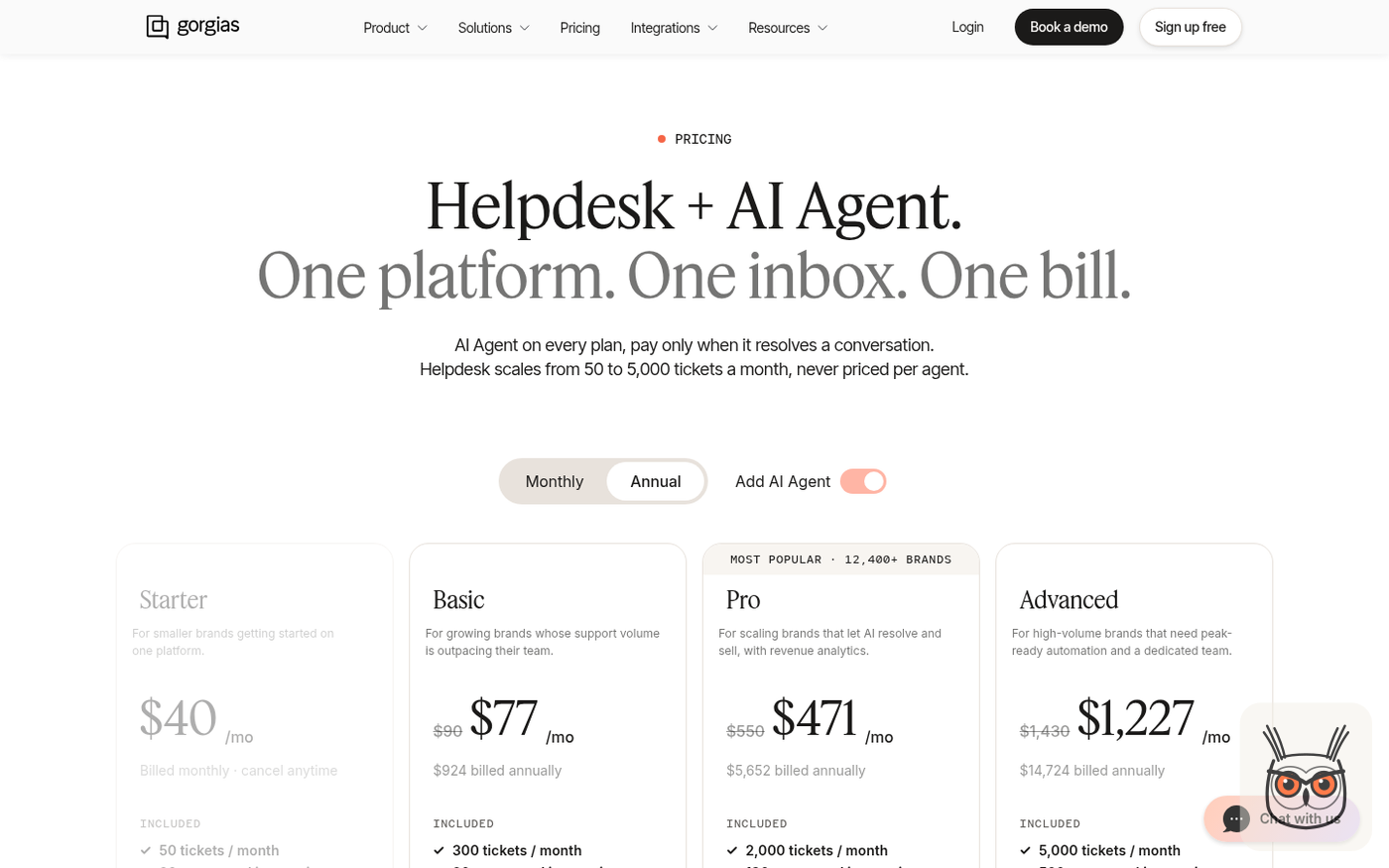
Gorgias is an ecommerce helpdesk with an AI agent that resolves support questions and acts as a shopping assistant in the same inbox. You pay a monthly add-on, then per resolved interaction. Verdict: the sensible AI sales agent for Shopify-style stores, as long as you know which per-interaction price applies to you.
- Best for: online stores that want support and a shopping assistant in one helpdesk.
- Pricing (13 Nov 2026): the AI Agent add-on starts at $27 a month on Basic. The Gorgias pricing page then shows $1.50 per automated interaction past your limit; its own blog says most plans are $0.90 per resolved interaction and starter plans $1.
- Where it breaks: I found no independent failure reports.
- Skip it if: you're not an ecommerce store. It's a support helpdesk with AI, not a B2B sales tool.
- CRM integrations: not listed on the pages I checked; it's built around the store platform rather than a CRM.
- Channels: not listed on the pages I checked; the docs describe a shopping assistant with its own conversion metrics.
- The cost view: handed-over conversations aren't charged, so you pay when it solves something, which is the fairest meter on this page.
The two Gorgias pages look like they disagree, but my read is that they describe two different moments: $0.90 to $1 is the in-plan rate and $1.50 is the overage. Ask which one your volume lands on, because a busy Black Friday is exactly when you cross the limit.
If you're on Shopify, the platform has its own agent options too, and for an ecommerce store the sales agent is mostly a support agent that can also sell. Pick the one that sits in the inbox you already use.
Best AI sales agent for marketing automation and AI agents
If your sales agent has to fit into marketing automation and other AI agents, pick the inbound tool that writes clean data into your CRM (Fin, or Qualified at higher traffic) and put your own workflow around it for routing, enrichment and follow-up. The agent talks to leads; the automation decides what happens next.
This is the setup I'd build for a marketing team, and it's the kind of thing I build in my AI automation and agents work. The AI sales agent owns the conversation. A workflow tool picks up the CRM record it creates and does the boring parts: enriches the company, scores the lead, starts the follow-up sequence Fin doesn't have, alerts the right rep in Slack. Each piece can be swapped without rebuilding the others.
And here's the bit people skip: an inbound agent with no traffic is a receptionist in an empty lobby. Qualified's plans start at 250K web sessions for a reason. The pages that bring buyers to your site, search and AI answers included, decide how much work your agent gets, which is why SEO and AEO belong in the same conversation as sales agents. Inbound marketing agents only scale with inbound.
The tool I'd avoid as the engine of marketing automation is a fully autonomous AI SDR, because it makes decisions your other automations can't see. Copilots and inbound agents leave a trail you can automate on. Black boxes don't.
Build or buy an AI sales agent?
Build an AI sales agent when the job is inbound qualification or research on your own data, where a workflow tool and a model cover most of it. Buy when the job is outbound email at volume, because the hard part there isn't the model. It's the sending infrastructure, the data and the domain reputation, which the bigger tools bundle.
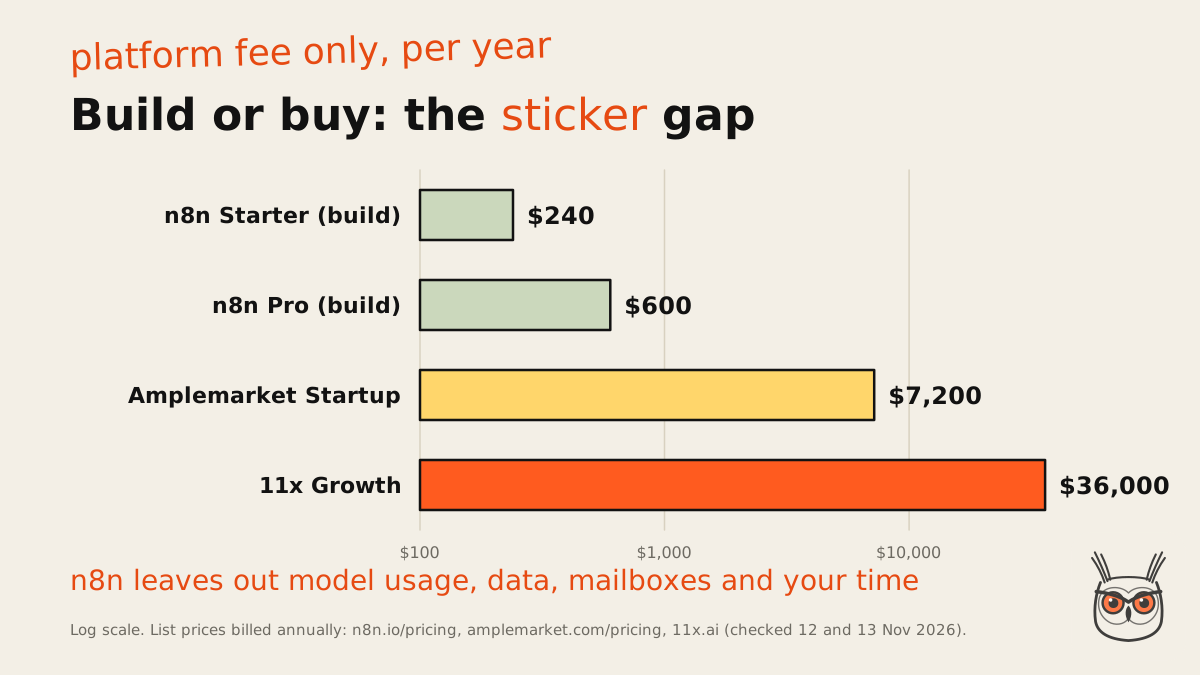
On sticker price alone, building looks like a rounding error. n8n cloud is $20 a month on Starter and $50 on Pro, billed annually; model usage is billed separately by your AI provider. Against $7,200 for Amplemarket Startup and $36,000 for 11x Growth, that's a gap you could park a car in. But the chart leaves out the expensive parts: the model calls, the contact data, the mailboxes, the warmup and your time. Those are the parts 11x bundles, and the parts that break.
Salesforce's FAQ says you can build your own sales agent and then recommends a trusted platform instead. (A CRM company recommending its CRM. Bold.) The open-source crowd disagrees: a Reddit post about an open-source sales agent on 23 October 2026 claimed it went from 500 to 10K downloads in two weeks. Both are selling something. One of them is selling attention, which is cheaper to make.
I've built agents like this, so I know where the time goes. My n8n agent that writes and publishes 200 ads a week took more work on the stops than on the writing: error exits, caps, and a rule that the bigger the possible damage, the earlier the agent stops and asks. A sales agent is the same job with higher stakes, because the output lands in a stranger's inbox.
My rule: build the inbound qualifier and the research agent, buy the outbound sender. If you're building, keep a person approving anything that reaches a customer, and size the stops to the damage.
How to set up an AI sales agent in 6 steps
To set up an AI sales agent: map the one job it owns, clean the CRM fields it will read and write, write its guardrails, connect the channels and calendar, run it in shadow mode with a person approving every send, then review it weekly. Put kill-switches on bounce and complaint rates before you scale volume.
Map the one job
Write down the single job (qualify inbound demo requests, say), the questions that decide a qualified lead, and where the handoff goes. One job, one owner, one exit.
Clean the CRM fields
The agent reads and writes your CRM. Fix lifecycle stages, owner fields and duplicate companies first, or it will confidently update the wrong record.
Write the guardrails
What it may promise, what it must never say (prices, discounts, roadmap), when it hands to a human, and the topics it refuses.
Connect channels and the calendar
Chat, email or phone, plus the booking tool. Check the small print: Fin needs a paid Calendly plan, for example.
Run in shadow mode
For the first weeks, a person approves every send or reads every conversation. Artisan, Amplemarket and Salesforce all have an approval or suggestive mode. Use it.
Review weekly, then scale
Read a sample of conversations, check bounce and complaint rates, and only then raise volume or loosen approval.
Steps two and four are where my own time goes when I set these up. Connecting the tools is the easy-looking step that eats an afternoon; if you're choosing the plumbing too, my comparison of business automation software covers which tool fits which stack.
What breaks in month one to three
Outbound pilots tend to look healthy for the first four weeks. Small list, low volume, warmed domains, everybody's happy. The trouble, according to one deliverability vendor's analysis, starts when volume goes up in weeks five to eight, and reputation becomes the constraint around month three. Mailbox providers read sending behaviour, not whether a robot wrote the email. That's one source, and it sells email verification, so treat it as a pattern to watch, not a law. But it matches the r/sales thread from 4 November 2026 asking whether letting AI agents run all outbound is going to blow up in our faces (69 comments, and the mood was not optimistic).
The thresholds are not a mystery. Google's sender guidelines ask bulk senders to keep spam complaints below 0.1% and never reach 0.3%, and require SPF, DKIM and DMARC for senders near 5,000 messages a day. The first four weeks are not evidence the setup works. They're evidence you haven't hit volume yet.
New angle, and none of the ranking pages cover it: the shared-domain problem. Artisan sends in your reps' names from your own domains, and so do most tools that skip managed mailboxes. If the agent's pattern gets your domain flagged, your human reps' email goes down with it, renewals and invoices included. I spent five years at Moosend, an email marketing SaaS, and the one lesson that leaked out of the deliverability team into everybody's head was that a domain's reputation takes weeks to lose and months to earn back. Send agent outbound from a separate domain and keep your main one for people.
The other failure is plain wrong answers. In a vendor-run survey published on 20 October 2026, Nylas found that 54% of companies had an AI agent error in the past 90 days and 18% had one send an incorrect email. Vendor survey, so hedge it, but it's why step five exists.
Will AI sales agents replace SDRs?
No, not the good ones. AI sales agents take the first conversation and the paperwork: answering, qualifying, booking, logging. People keep anything a wrong answer makes expensive, like pricing, negotiation, a nervous champion or an angry customer. Expect smaller SDR teams doing more of the human part, not empty desks.
Every vendor on this list says some version of "no". SalesCloser's FAQ: "No. It gets every lead to them." Artisan: Ava runs the repetitive outbound work and you decide when a human steps in. Salesforce: selling will always involve real relationships between people. Very reassuring.
Then 11x's pricing page compares its Growth plan with a fully loaded SDR at $8,000 to $12,000 a month. You can't say "it won't replace anyone" and price against a salary in the same breath. Well, you can. It's just funny.
My view: rank the work by what a wrong output costs. The agent takes the cheap mistakes (a clumsy first reply, a meeting booked on the wrong day) and people keep the expensive ones. That's also why the most common B2B experiment in Growth Unhinged's 2026 GTM report was signal-based outbound, at 50% of companies: teams are using data and automation to pick who to contact, and still putting a person on the reply. And if you're still deciding whether a sales agent is even your first project, my guide on which processes to automate first is the better starting point.
So, what does a qualified lead cost you?
At the top I said the cheapest number on this page was $0.99 and also the most misleading. Now you know why: the qualified lead costs $9.99 on Fin, $36,000 a year buys 2,000 prospects a month on 11x, and half the vendors won't say at all.
So do the sum before the demo. Pick one job, start inbound if you have traffic, keep a person approving, and keep the agent off your main domain. If you'd rather have someone wire the agent, the CRM and the follow-up together, that's what I do in AI automation and agents. Price the qualified lead, not the chat.
Frequently asked questions
What is an AI sales agent?
An AI sales agent is software that does sales development work on its own: it talks to or emails leads, asks qualifying questions, books meetings and updates your CRM, handing anything complex to a person.
Vendors draw the line differently (Fin by scope, Salesforce by autonomy, SalesCloser by channel), so judge each one by the job it owns: inbound conversations, outbound email or CRM work for your reps.
How much does an AI sales agent cost?
As of 13 November 2026, from $0.99 per outcome and $9.99 per qualification on Fin, $2 per conversation on Agentforce, $600 a month on Amplemarket and $36,000 a year on 11x Growth.
Artisan, Qualified, Creatio and SalesCloser publish no price. Compare tools on cost per qualified lead rather than headline price, because each vendor bills a different unit.
Can AI sales agents replace SDRs?
Not fully. They take the first conversation, the qualifying questions, the booking and the CRM updates, while people keep pricing, negotiation and anything where a wrong answer is expensive.
Every vendor here says its agent hands complex conversations to a human. Expect SDR teams to get smaller and more senior, not to disappear.
AI sales agent vs chatbot: what's different?
A chatbot follows a script and stops when the script runs out. An AI sales agent decides its next step, qualifies the lead, books the meeting and writes the result into the CRM.
The practical test: ask what the tool does when a buyer asks something it wasn't scripted for. A good agent answers within its brief or hands off with a summary; a chatbot loops.
Can I build my own AI sales agent?
Yes, especially for inbound qualification or lead research on your own data. A workflow tool like n8n (from $20 a month, billed annually, plus model usage) and a language model cover most of it.
For outbound email at volume, buying is usually safer, because sending infrastructure, contact data and domain reputation are the hard parts. My guide on how to build AI agents walks through the build.
How do I connect an AI sales agent to my CRM?
Most connect natively: Fin to Salesforce and HubSpot, Artisan to Salesforce and HubSpot, SalesCloser to HubSpot, Pipedrive and Zoho, and Agentforce lives inside Salesforce. Clean your CRM fields before you connect.
Give the agent its own user, limit what it can edit, and start in a suggestive or approval mode so a person sees each change before it sticks.
